What Are Warehouse Robots and How Do They Work?
Warehouse robots are changing how goods move through modern fulfillment centers. They are not a single machine type. The term includes autonomous mobile robots, robotic arms, automated storage systems, and sorting machines. Each system handles a specific warehouse task.
An autonomous mobile robot may carry a plastic tote from storage shelves to a picking station. It uses cameras, lidar, floor markers, and software maps to navigate safely. A robotic arm can identify packages, grip different shapes, and place them onto a conveyor. Warehouse software coordinates these movements with inventory records, order data, and human workers. The goal is simple: reduce walking, shorten processing time, and improve consistency.
Raffaello D’Andrea, co-founder of Kiva Systems and a leading warehouse robotics expert, has described the human-machine relationship this way: “The idea is not to replace people, but to augment people.” That principle remains important. Warehouse robots work best when they manage repetitive transport or lifting, while employees handle judgment, exceptions, and customer-sensitive decisions. Still, the technology is not flawless. A reflective package can confuse a camera. A damaged barcode can stop a smooth workflow. Poorly planned routes may create congestion near a busy packing station.
This article explains what warehouse robots are, how their sensors and control systems work, and where their practical limits appear. The subject deserves careful attention. Faster is not always better. Reliable automation must also be safe, measurable, maintainable, and adaptable to real warehouse conditions.
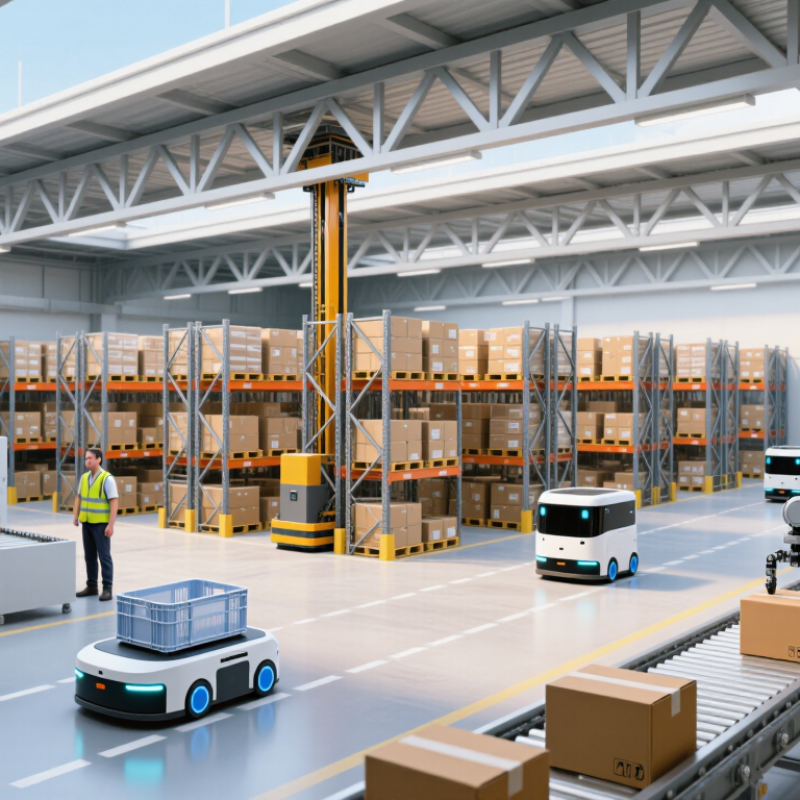
Table of Contents
[Hide]
What Are Warehouse Robots?
Warehouse robots are mobile machines or fixed robotic systems that move, store, retrieve, sort, or handle goods inside a warehouse. They include autonomous mobile robots that navigate around people and shelving, guided vehicles that follow defined routes, robotic arms that pick items, and automated storage systems. Some carry. Others pick. The label is imperfect: a robot may perform only one task, while people still manage exceptions, damaged packages, and unusual orders.
Most mobile units combine cameras or other sensors, onboard software, and safety scanners to locate obstacles and travel through aisles. Warehouse control software assigns jobs, such as bringing a tote to a packing station; fleet software coordinates routes so vehicles do not crowd narrow passages. A worker may scan an item, place it in a tote, and send the tote onward. The level of autonomy varies. A robot can navigate independently without deciding what a customer should order.
The International Federation of Robotics reported that sales of professional service robots for transportation and logistics reached nearly 113,000 units in 2023, a 35% increase from 2022. This points to growing adoption, not proof that every warehouse benefits equally. Performance depends on aisle layout, item variety, and the quality of inventory data. A practical assessment should measure walking distance, throughput, and error rates before and after deployment. One overlooked detail: poorly maintained maps can send an otherwise capable robot to the wrong location.
What Are Warehouse Robots and How Do They Work?
| Robot Type | Main Warehouse Task | How It Works | Navigation or Guidance | Typical Human Role |
|---|---|---|---|---|
| Autonomous mobile robot (AMR) | Moves totes, cartons, or other goods between work areas. | Uses onboard sensors and a control system to travel to assigned destinations and adjust its route when obstacles appear. | Often combines cameras, lidar, or other sensors with a digital map and localization software. | Workers load or unload items, supervise exceptions, and coordinate tasks through warehouse software. |
| Automated guided vehicle (AGV) | Transports pallets, carts, or materials along planned routes. | Follows a defined path and stops or changes behavior when its control or safety systems detect an obstruction. | May follow floor markings, magnetic guides, reflectors, or a mapped route, depending on the system. | Staff keep routes clear, handle loading and unloading, and respond to alerts or blocked paths. |
| Goods-to-person system | Brings storage containers or shelves to a picking station. | Robots retrieve and deliver inventory so a worker can pick items without walking to each storage location. | Uses mapped storage locations and warehouse inventory or task-management software. | A worker identifies and picks the requested quantity, then confirms the task at the station. |
| Automated storage and retrieval system (AS/RS) | Stores and retrieves cases, totes, or pallets in dense storage areas. | Automated cranes, shuttles, or lifts move inventory between storage positions and input or output points. | Runs on fixed rails, lift structures, or other engineered paths, directed by a control system. | Workers replenish the system, manage inventory exceptions, and maintain equipment. |
| Robotic picking arm | Grips and transfers items for picking, sorting, or packing. | A robotic arm uses a gripper or suction tool to handle items; vision and software can help identify object location and orientation. | Typically works within a defined cell, using programmed positions and, in some systems, camera-based guidance. | Staff replenish items, check uncertain picks, and manage products the robot cannot reliably handle. |
| Autonomous inventory-scanning robot | Collects data about labels, stock locations, or inventory levels. | Travels through aisles and captures images or sensor readings for comparison with inventory records. | Uses onboard sensors and a mapped route to move through designated areas. | Workers review discrepancies and verify inventory issues that require physical investigation. |
Related Posts
-
10 Best Warehouse Robots for Global Buyers?
-
How to Choose the Right Service Robot for Your Business?
-
Top 10 Warehouse Robots Transforming Supply Chain Efficiency?
-
Top 10 Picking Robots Revolutionizing Warehouse Efficiency in 2023
-
2026 How to Use a Robotic Arm for Automation in Various Industries?
-

What is a Packaging Robot and How It Revolutionizes the Packaging Industry
Customers




Smart Robotics brand movie
Watch video