China’s industrial robot market is no longer a story of scale alone. It is also about precision, integration, and dependable after-sales support. For buyers comparing China’s top industrial robot manufacturers and suppliers, those details matter on the factory floor: a robot must repeat a weld accurately, keep pace with a conveyor, and fit existing safety systems.
The International Federation of Robotics (IFR), in its World Robotics 2024 report, recorded 276,288 industrial robot installations in China in 2023—about 51% of global installations. The IFR also reported a worldwide operational stock of 4,281,585 industrial robots that year. These figures show the market’s weight, but they do not tell buyers which supplier best fits a particular line. That takes closer inspection.
As IFR President Marina Bill said, “The annual number of installations in 2023 was the second-highest in history, just 2% below the record year 2022.” This growth provides useful context, not a guarantee of performance. A supplier’s published payload or reach may look impressive, yet cycle time, controller compatibility, spare-parts access, and service response can decide whether a project succeeds. Small details.
This guide examines leading Chinese manufacturers and suppliers through practical criteria, including product range, applications, technical support, and export experience. Company claims should be checked against documented specifications and customer requirements. No ranking can replace a factory trial. That caveat is easy to overlook.
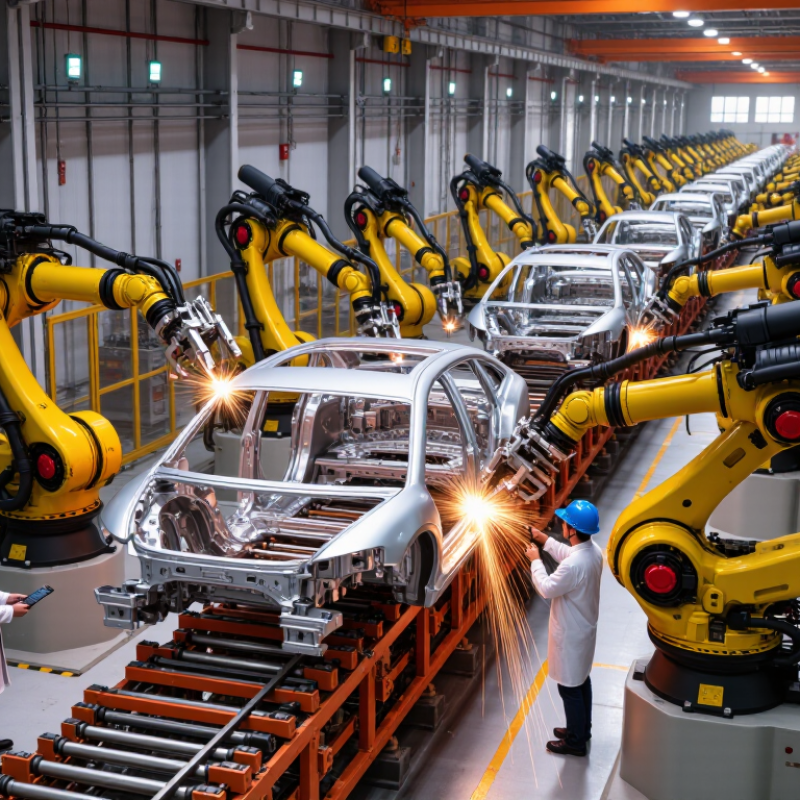
China’s industrial robot industry has expanded from basic assembly systems into a broad manufacturing ecosystem. Robots now support welding, painting, packaging, machining, inspection, and warehouse movement. Demand is rising. Automotive production remains important, but electronics, batteries, metalworking, food processing, and medical equipment are also adopting automation.
Major production clusters have formed around coastal manufacturing regions and inland technology centers. These areas combine component suppliers, system integrators, engineering teams, and technical colleges. This proximity can shorten delivery times and simplify maintenance. Local suppliers increasingly produce controllers, servo motors, reducers, sensors, and end effectors. However, performance can differ greatly between product categories and working conditions.
In practical factory projects, installation quality often matters as much as robot specifications. A six-axis robot may perform poorly if fixtures, safety systems, or programming are unsuitable. Experienced integrators usually study cycle time, payload, reach, floor space, and operator routines before recommending equipment. Data from production trials should support these decisions, not optimistic brochures. The gap remains. Some smaller factories still lack trained technicians and reliable after-sales support, which can delay repairs and reduce the expected return on investment. China’s industry is advancing quickly, but standardization, software capability, and long-term service still require careful attention.
Industrial robots differ by movement, payload, reach, and control method. Articulated robots use several rotary joints, much like a human arm. They handle welding, painting, machine tending, and heavy palletizing. Their flexible reach suits complex production cells, but programming can take time.
SCARA robots move quickly across horizontal planes. They often place electronic parts, tighten screws, or assemble small components. Delta robots use lightweight parallel arms for rapid picking and packaging. Their ceiling-mounted design works well beside conveyor belts. Cartesian robots travel along straight axes. They provide predictable positioning for cutting, dispensing, and material handling.
Applications depend on the workpiece and factory layout. A six-axis robot may reach around fixtures, while a Cartesian unit may offer simpler maintenance. Collaborative robots can support workers in controlled tasks, such as inspection or light assembly. They still require risk assessment, force limits, guarding, and reliable emergency stops. Safety is not optional.
A practical selection should examine payload, cycle time, reach, repeatability, ingress protection, and available floor space. Operators also need clear access for cleaning and calibration. A fast robot can still create delays if its gripper slips. Details matter. In real production, integration often proves harder than the robot itself. Sensors may need adjustment under changing light, dust, or surface conditions. This is where technical support and documented testing become valuable. Some early assumptions will be wrong. Careful trials reveal them before full deployment.
Global Industrial Robot Installations by Industry (2023)
Electrical and electronics and automotive were the two largest industry groups shown. Shares are approximate percentages of annual installations; other industries are not included in this chart.
Source: International Federation of Robotics, World Robotics 2024. Percentages are rounded; categories shown are selected industries.
China’s industrial robot sector includes manufacturers and suppliers serving automotive, electronics, metalworking, and logistics operations. Their offerings can range from robotic arms and controllers to integration services, safety equipment, and operator training. Buyers should compare complete solutions, not just arm specifications.
A useful evaluation starts with the workpiece, cycle time, payload, and required reach. Ask suppliers for application records involving similar materials and production conditions. Request clear details on repeatability, maintenance intervals, spare-parts availability, and local technical support.
Practical demonstrations matter. Watch a robot handle your actual component, including awkward angles and variations between parts. A neat showroom cycle may not reflect a dusty, crowded factory floor.
Strong suppliers explain limits as clearly as capabilities. They should identify integration risks, describe commissioning steps, and provide realistic timelines.
Check whether service staff can troubleshoot on site or remotely, and ask how software updates and training are handled.
Compare quotations line by line; installation, guarding, programming, and after-sales service may be excluded. Paper specifications help, but they are not the whole story.
Even a careful assessment can miss small workflow problems, so a pilot installation may reveal issues before wider deployment.
Chinese industrial robot suppliers differ less by headline specifications than by how well their systems fit a factory’s daily work. The International Federation of Robotics reported 276,288 robot installations in China in 2023, about 51% of global installations. That scale supports a broad supply base, but it does not guarantee equal engineering depth or service quality. Buyers should compare payload and reach alongside controller compatibility, safety functions, spare-part availability, and local commissioning capacity. A robot that meets the specification sheet can still underperform if its gripper struggles with oily parts or its vision system fails under changing light.
Technology also varies by application. Some suppliers focus on high-speed handling and welding; others offer collaborative robots, machine tending, or integrated vision. Ask for cycle-time tests using your actual workpiece, not a showroom sample. Small details matter. Check recovery steps after a fault, operator training hours, and who supports software updates. IFR’s World Robotics 2024 report also recorded more than 1.8 million industrial robots operating in China, showing the importance of long-term maintenance. Yet published data cannot show how quickly a particular supplier responds at your site. Service promises deserve verification. A pilot cell and a written response-time plan can expose gaps before a full-line purchase. Even then, integration estimates may be optimistic; build in time for adjustment.
China Top Industrial Robot Manufacturers and Suppliers
Choosing an industrial robot supplier in China requires more than comparing unit prices. The International Federation of Robotics reported 541,302 industrial robot installations worldwide in 2023. China accounted for about 276,000 installations, showing its manufacturing scale and supplier depth.
Start with application evidence. Ask the supplier to test your real workpiece, tooling, payload, reach, and cycle time. A short video is not enough. Request measured repeatability, energy use, and downtime records from similar projects. The International Organization for Standardization’s ISO 10218 standards also provide a useful reference for robot safety and integration. Suppliers should explain guarding, emergency stops, risk assessment, and operator training in clear language.
Service capability often matters more than a polished quotation. Check local engineers, spare-parts availability, software support, and response times. A robot may run well in a demonstration room but fail under dust, heat, vibration, or three-shift production. Ask for acceptance criteria before signing. These should cover accuracy, uptime, communication with existing equipment, and recovery after faults. A low initial price can hide integration costs. I learned this the hard way. No checklist is perfect. Visit an operating customer site when possible, and speak with maintenance staff, not only sales representatives. Also review software updates, data access, and long-term training arrangements before selecting a supplier.
| China Top Industrial Robot Manufacturers and Suppliers — Key Factors for Choosing an Industrial Robot Supplier in China | |||
|---|---|---|---|
| Selection Factor | What to Assess | How to Verify | Why It Matters |
| Application Fit | Robot type, axis count, payload, reach, cycle requirements, and suitability for the intended task, such as welding, palletizing, machine tending, or assembly. | Provide the supplier with the workpiece, process, layout, and target cycle time; request a documented technical proposal and application assessment. | A robot must meet the process requirements while maintaining the required reach, payload, and operating speed. |
| Payload and Reach | Rated payload, wrist load limits, tool weight, workpiece weight, center of gravity, and working envelope. | Compare the proposed model’s official technical specifications with the combined weight and geometry of the tool and workpiece. | Exceeding load limits or selecting insufficient reach can affect performance, reliability, and safe operation. |
| Accuracy and Repeatability | Specified pose repeatability and the accuracy needed for the production task. | Review the technical datasheet and, where precision is critical, define acceptance tests using representative parts and tooling. | Repeatability affects whether a robot can consistently return to taught positions; application-level accuracy also depends on tooling, calibration, and system setup. |
| Integration Compatibility | Controller interfaces, industrial communication options, safety I/O, programming tools, and compatibility with existing PLCs, sensors, and production equipment. | Request interface documentation and confirm the proposed connection method with the machine builder or plant automation team. | Clear compatibility reduces integration uncertainty and helps the robot work with the wider production system. |
| Safety and Compliance | Robot and cell risk assessment, guarding, emergency stops, safety functions, and applicable regulations and standards for the installation location. | Ask for relevant declarations, safety documentation, and information needed for a site-specific risk assessment. Confirm local regulatory requirements independently. | Robot safety depends on the complete application and installation, not only on the robot arm. |
| Application Experience | Experience with similar processes, materials, operating conditions, and required production volumes. | Request anonymized project examples, process descriptions, and, when available, a demonstration using comparable parts or a representative simulation. | Relevant experience can help identify tooling, process, and integration issues before deployment. |
| Technical Support and Training | Availability of commissioning assistance, operator and maintenance training, troubleshooting support, and documentation in the required language. | Confirm support channels, service hours, response arrangements, training scope, and the documents supplied with the system. | Accessible support helps the operating team maintain the system and resolve issues effectively. |
| Spare Parts and Service Coverage | Availability of replacement parts, service personnel, warranty terms, and support coverage at the installation site. | Ask for written warranty conditions, parts ordering procedures, service coverage details, and recommended maintenance requirements. | Parts and service arrangements influence maintenance planning and potential downtime. |
| Total Cost of Ownership | Robot and controller price, end-of-arm tooling, safety equipment, integration, installation, training, maintenance, and operating costs. | Compare itemized quotations with the same scope, assumptions, warranty period, and service requirements. | The purchase price alone does not represent the full cost of deploying and operating a robotic cell. |
| Delivery and Project Planning | Production lead time, customization scope, shipment arrangements, installation schedule, and commissioning responsibilities. | Request a written project schedule identifying milestones, deliverables, dependencies, and the responsibilities of each party. | Defined planning helps align equipment delivery with facility readiness and production launch requirements. |
| Supplier Documentation | Datasheets, manuals, electrical drawings, maintenance instructions, software information, and parts lists. | Review sample documentation before ordering and confirm its format, language, and delivery timing. | Complete documentation supports installation, operation, maintenance, and future troubleshooting. |
Watch video