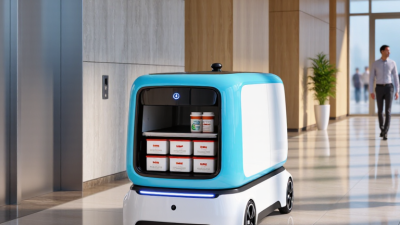
Choosing the right delivery robot is not simply a technology purchase. It affects delivery speed, staff workload, customer trust, and daily operating costs. A robot moving meals across a hotel lobby needs different features from one carrying parcels through a busy warehouse.
Real-world testing matters. Watch how the machine handles narrow doors, uneven flooring, crowded hallways, and sudden stops. Check its navigation system, battery range, payload capacity, security controls, and maintenance support. A polished demonstration can hide practical weaknesses. That happens more often than buyers expect.
The seven tips in this guide focus on decisions that remain useful after installation. They consider site conditions, delivery volume, software integration, safety performance, accessibility, and long-term value. Reliable manufacturers should explain limitations clearly, provide measurable performance data, and offer responsive technical assistance. Independent reviews and pilot programs can strengthen that evaluation.
Small details matter. Does the robot fit inside the lift? Can staff clean its storage compartment quickly? Will customers understand its alerts without extra help? These questions may seem minor, yet they shape everyday acceptance. One weakness can disrupt an entire route. A careful buyer should also question attractive promises and compare them with observed results. The best choice may not be the fastest or most advanced model. It should be dependable, understandable, and suitable for the environment where it will operate. Mistakes are possible, even with careful planning. That is why a limited trial, honest feedback, and regular performance reviews should guide the final decision.
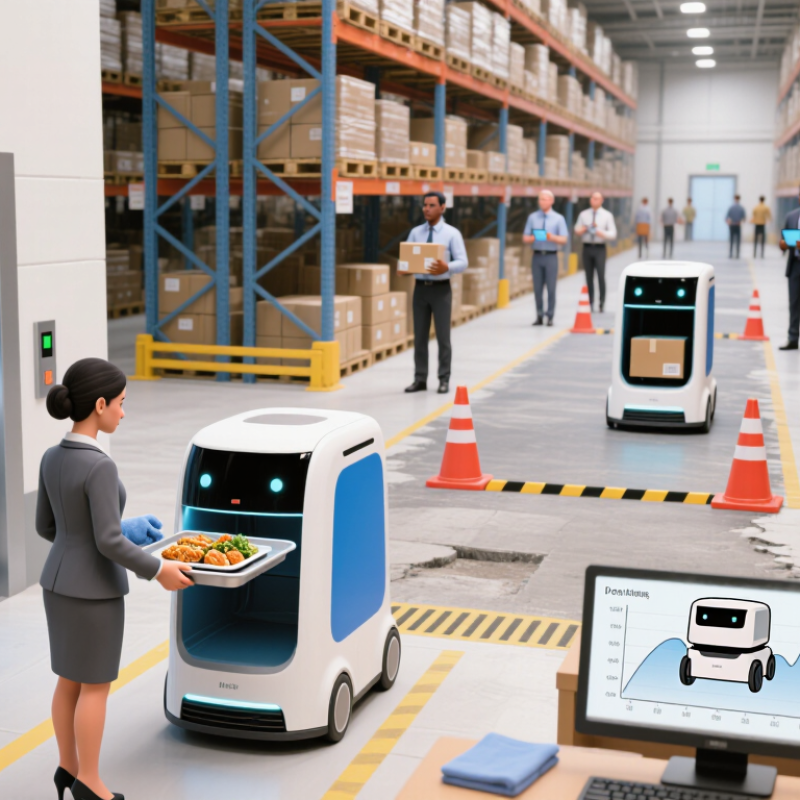
7 Tips for Choosing the Best Delivery Robot
Define the Delivery Robot’s Intended Tasks and Operating Environment
A delivery robot should match the work, not just look impressive in a product demonstration. Define each task clearly. Will it carry meals, documents, groceries, or heavier supplies? Record the payload’s weight, size, temperature needs, and handoff method. A robot moving meals across a smooth campus needs different capabilities from one serving a busy medical facility.
Tip 1: Walk the planned route before choosing equipment. Measure door widths, elevator access, ramps, slopes, floor changes, and average pedestrian traffic. Note weak signals, bright sunlight, rain exposure, and areas with limited lighting. Small obstacles can become daily delays. My first site survey missed a narrow doorway, which later required manual assistance.
Tip 2: Match operating features to real conditions. Select suitable clearance, battery range, weather protection, navigation accuracy, and stopping behavior. Ask how the robot handles blocked paths, unexpected crowds, and temporary construction. Test these situations during a controlled pilot. Review delivery times, failed handoffs, battery use, and intervention frequency. A short route may still be difficult when elevators are shared or sidewalks are crowded.
Tip 3: Define success before deployment. Set measurable limits for delay, payload damage, human assistance, and route completion. Include staff feedback and maintenance records. Be willing to revise the original plan. The best choice may be a simpler robot if the environment changes often. Reliable performance matters more than a polished demonstration.
Before selecting a delivery robot, compare the expected payload, route complexity, weather exposure, and interaction with pedestrians. The 1–5 planning scores below represent typical operating demands, where 5 indicates a higher requirement.
How to use this chart: Indoor corridors usually require precise navigation and safe pedestrian interaction, while campus sidewalks require stronger weather protection and obstacle handling. Warehouse routes generally prioritize payload capacity and repeatable navigation over public-space interaction.
Choosing a delivery robot requires more than checking its advertised range. Navigation determines whether the robot follows planned routes accurately. Look for reliable mapping, clear route updates, and stable performance indoors and outdoors. A useful system should handle elevators, ramps, narrow corridors, and changing floor layouts. Watch it work.
Sensing technology affects every movement. Cameras, depth sensors, and proximity detectors should identify people, carts, glass doors, and low obstacles. Ask how the robot performs in dim lighting, crowded spaces, and reflective environments. Sensor coverage matters, but data processing matters too. A robot may detect an object without understanding its safest path. Test real conditions, not only controlled demonstrations.
Obstacle avoidance should feel cautious rather than nervous. The robot needs to slow down, stop smoothly, and choose a new route when someone blocks its way. Check whether it protects fragile packages during sudden stops. During a field test, record response distance, recovery time, and false alarms. I have seen systems pause repeatedly near harmless shadows, wasting valuable time. That weakness may appear minor during a short trial, yet it can disrupt daily operations. Independent safety documentation and maintenance records also deserve careful review. No navigation system is perfect. Honest testing reveals where human oversight remains necessary.
| No. | Selection Tip | System or Data Dimension | What to Compare | Typical Practical Reference | Why It Matters |
|---|---|---|---|---|---|
| 1 | Match navigation to the site | Navigation method | Compare map-based SLAM, visual navigation, LiDAR-assisted navigation, and satellite positioning. | SLAM is generally suitable for indoor or mixed environments; satellite positioning is more useful outdoors with a clear sky view. Multi-sensor systems are typically more resilient. | The correct navigation method reduces localization errors and route interruptions. |
| 2 | Evaluate localization accuracy | Positioning accuracy and recovery | Check reported position error, relocalization time, performance near reflective surfaces, and behavior after temporary signal loss. | For many indoor delivery tasks, decimeter-level localization is a practical target; actual accuracy varies with map quality, lighting, geometry, and sensor configuration. | Accurate localization helps the robot stop at the correct door, station, or handoff point. |
| 3 | Compare sensing coverage | Sensor types and field of view | Review LiDAR, depth cameras, RGB cameras, ultrasonic sensors, wheel encoders, inertial sensors, and optional radar. | LiDAR supports geometric ranging; depth cameras provide three-dimensional image data; ultrasonic sensors are useful at short range; encoders and inertial sensors support motion estimation. | Different sensors cover different weaknesses, including poor lighting, transparent objects, dust, and narrow spaces. |
| 4 | Test obstacle detection and avoidance | Detection range, stopping distance, and replanning | Ask how the robot detects people, carts, pets, low obstacles, overhanging objects, glass, and temporary blockages. | Stopping distance increases with speed and payload. A safe system should detect obstacles early, slow down smoothly, stop when required, and replan when a path remains blocked. | Obstacle avoidance is directly linked to pedestrian safety, property protection, and delivery reliability. |
| 5 | Check mobility and route limits | Speed, clearance, slope, and surface capability | Compare maximum operating speed, turning radius, ground clearance, doorway width, ramp capability, and performance on wet or uneven surfaces. | Indoor robots commonly operate at walking speeds. Real capability depends on wheel design, payload distribution, floor friction, ramp grade, and local safety rules. | A robot that cannot negotiate the site’s routes will require manual intervention or infrastructure changes. |
| 6 | Assess operating endurance | Battery, charging, and uptime | Compare operating time per charge, charging duration, automated docking, battery replacement, and performance under maximum payload. | Actual runtime varies significantly with speed, terrain, payload, temperature, sensor load, and wireless communication. Evaluate uptime per shift rather than battery capacity alone. | Reliable charging and battery management prevent missed deliveries and reduce labor for daily operation. |
| 7 | Verify fleet and safety controls | Remote monitoring, cybersecurity, and fail-safe behavior | Review emergency stop functions, manual override, remote assistance, event logs, software updates, access control, and data protection. | A production-ready system should enter a safe state during communication loss, sensor faults, low battery, or blocked routes, with clear alerts for operators. | Operational visibility and fail-safe controls improve safety, maintenance response, and fleet scalability. |
Note: Performance depends on site layout, lighting, surface conditions, payload, weather, sensor configuration, software settings, and applicable safety requirements. Validate all specifications through an on-site pilot.
Payload capacity should match real delivery conditions, not optimistic estimates. Add the container, insulation, packaging, and a safety margin. A robot rated for 20 kilograms may struggle on ramps when carrying 18 kilograms. Measure twice. In field deployments, uneven pavement and frequent stops can reduce practical capacity. The International Federation of Robotics reported more than 100,000 transportation and logistics robots sold in 2023. That growth makes careful specification more important, not less.
Battery life requires a route-based calculation. Review expected distance, slopes, weather, payload weight, and idle time. Ask for operating data under loaded conditions, not laboratory claims. The U.S. Department of Energy notes that temperature, charging habits, and battery age affect lithium-ion performance. A robot promising ten hours may deliver less after months of daily use. This is easy to overlook. I would also examine remaining battery capacity after a full route, because the final delivery should not depend on luck.
Charging requirements can determine fleet productivity. Check charging duration, connector access, ventilation, floor space, and overnight scheduling. The International Energy Agency reported that global battery demand reached 750 GWh in 2023, showing how quickly charging infrastructure is scaling. Still, bigger batteries are not automatically better. They add weight and may reduce payload efficiency. Compare opportunity charging with planned overnight charging, then test both during the busiest operating period. Real routes may expose weaknesses that a specification sheet hides.
Safety should lead every delivery robot evaluation. IFR’s World Robotics 2024 report recorded more than 100,000 professional service robots sold for transport and logistics in 2023. That growth increases the need for disciplined testing. Check obstacle detection, emergency stopping, speed limits, lighting, and safe behavior around children, cyclists, and wheelchair users. Test it outdoors. A robot that stops reliably on dry pavement may fail beside a wet curb. Small details matter.
Reliability requires more than a strong battery. Review delivery success rates, charging cycles, weather resistance, navigation accuracy, and recovery procedures. Ask for maintenance records and independently verified test results. Seven practical checks include sensor coverage, braking distance, communication stability, payload protection, uptime, remote support, and fault reporting. One missed curb is enough. I would distrust impressive demonstrations without long-duration data from similar streets. Perfect results also deserve questioning.
Regulatory compliance must match every operating location. ISO 3691-4:2023 offers relevant safety guidance for applicable driverless industrial vehicles, but it does not replace local requirements. Confirm rules for sidewalks, accessibility, electromagnetic safety, privacy, insurance, and human oversight. NIST’s AI Risk Management Framework also supports documented risk controls and monitoring. Keep an audit trail. Compliance paperwork can look complete while field procedures remain unclear. Ask who responds when sensors disagree, pedestrians block the route, or the robot loses network access.
Choosing a delivery robot starts with the software, not the polished shell.
Ask whether its fleet platform connects with your order system, access controls, maps, and reporting tools. A useful integration should support documented APIs, secure authentication, and clear data ownership.
Request a live demonstration using your actual delivery workflow. Test a delayed order, a blocked corridor, and a customer address change. Small failures reveal more than smooth presentations.
Confirm how quickly the robot receives updates. Also check whether staff can operate essential functions without specialist coding skills.
Maintenance deserves equal attention.
Examine battery replacement intervals, wheel and sensor inspection schedules, cleaning procedures, and local service coverage. Ask which parts remain available after three years. A robot that waits ten days for a sensor can disrupt an entire shift.
Review remote diagnostics, response times, training, and loaner arrangements. Keep a written maintenance log from day one.
We once underestimated charging-space requirements. The robot performed well, but the storage area became crowded. That mistake changed our site checklist.
Calculate total cost over its expected life, not only purchase price.
Include installation, software subscriptions, integration labor, charging equipment, insurance, staff training, repairs, downtime, and eventual replacement. Compare cost per completed delivery, not cost per unit.
Use conservative assumptions for utilization and battery life. Ask for a three-year cost model with strong-demand and weak-demand scenarios. Check contract terms for price increases, data export, and early termination.
A low quote can become expensive when every exception requires paid support.
Leave room for human oversight. Automation helps, but it does not remove responsibility for service quality.
Watch video