Who Are the Top Quartz Glass Manufacturers in China?
China’s Quartz Glass sector serves semiconductor, optical, lighting, and laboratory markets. Yet a polished website does not prove a factory can deliver stable material. Buyers need to examine the details: silica purity, bubble and inclusion levels, dimensional tolerances, machining capability, and batch-to-batch consistency. A clear tube under inspection lighting can reveal visible defects, but it cannot tell the whole story. Ask for test methods, sample records, and application-specific evidence.
Donald B. Keck, a glass scientist known for pioneering low-loss optical fiber, offers a useful point of reference. In paraphrase, his work shows that optical performance depends on both material quality and manufacturing control. That is not a direct quotation, and the distinction matters. Supplier comparisons should separate verified specifications from marketing claims.
This guide looks at leading Chinese manufacturers through practical buyer criteria, including product range, production capability, quality documentation, customization, and export experience. A top-ranked name may not suit every project. A supplier with strong semiconductor-grade capability, for example, may not be the best choice for a small batch of sight glasses. Details matter.
Expect useful comparisons, but not false certainty. Public information can be incomplete, and factory claims deserve independent checking. Before placing an order, confirm the grade, tolerances, inspection requirements, and sample acceptance criteria in writing. Small omissions can become expensive.
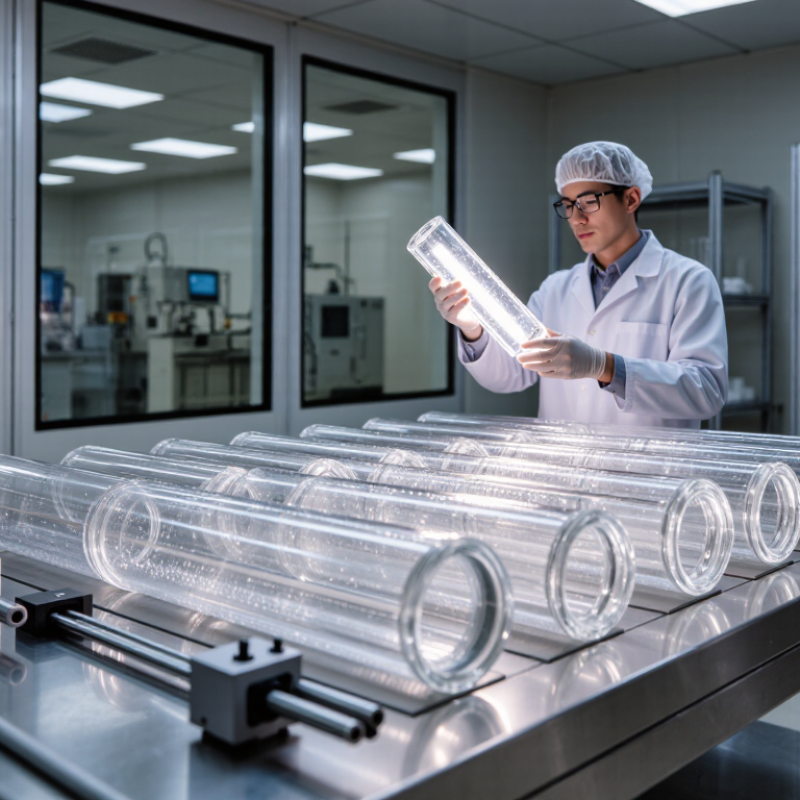
Table of Contents [Hide]
What Quartz Glass Is and Why It Matters
Quartz glass, often called fused silica, is made by melting high-purity silica and cooling it without forming crystal grains. Its disordered structure gives it useful optical and thermal properties. It can transmit ultraviolet light in suitable grades and withstand rapid temperature changes better than many ordinary glasses. Not ordinary glass. That distinction matters near hot furnaces and precision optics.
The U.S. Geological Survey’s Mineral Commodity Summaries 2024 estimated global industrial sand and gravel output at about 400 million metric tons in 2023. This figure covers many silica uses; it is not a measure of quartz-glass production. Quartz glass requires especially clean feedstock, and trace impurities can affect transmission or performance. The number offers context, not a direct market-size estimate.
In semiconductor processing, quartz components may sit inside hot environments where contamination and dimensional stability matter. In optical systems, carefully controlled purity helps preserve light transmission. Engineers still have to match grade, geometry, and surface finish to each application. A tube may look clear, yet small defects or impurities can matter. It is easy to overlook how much performance depends on details that are hard to see.
| Who Are the Top Quartz Glass Manufacturers in China? - What Quartz Glass Is and Why It Matters | |||
|---|---|---|---|
| Quartz glass, also called fused silica, is made by melting high-purity silica. Its low thermal expansion, heat resistance, and optical properties make it useful in demanding industrial applications. This table summarizes typical material data and practical criteria for evaluating manufacturing capabilities; it does not rank or identify individual companies. | |||
| Category | Dimension | Typical information | Why it matters |
| Material | Composition | Fused silica is predominantly silicon dioxide (SiO₂). Commercial purity depends on the feedstock and manufacturing route; high-purity grades commonly exceed 99.9% SiO₂. | Impurities can affect optical transmission, electrical behavior, and performance in high-temperature or semiconductor processes. |
| Material | Density | Approximately 2.2 g/cm³ for typical fused silica. | Useful for estimating component weight; the exact value varies slightly with composition and grade. |
| Thermal performance | Coefficient of thermal expansion | About 0.5 × 10⁻⁶ K⁻¹ over approximately 20–300°C for typical fused silica. | Very low expansion helps components resist dimensional change and thermal shock; the value depends on grade and temperature range. |
| Thermal performance | Characteristic temperatures | Typical reference values are around 1,120°C for the strain point, 1,215°C for the annealing point, and 1,665°C for the softening point. | These are material test characteristics, not recommended continuous-use temperatures; actual service limits depend on load, environment, and design. |
| Optical performance | Refractive index | Approximately 1.4585 at 589.3 nm for a common fused-silica reference. | Relevant to lenses, windows, and optical assemblies; refractive index varies with wavelength and material grade. |
| Optical performance | Light transmission | Transmission depends on wavelength, thickness, surface finish, hydroxyl content, and grade. UV-transmitting and infrared-oriented grades are available. | Buyers should specify the wavelength range and required transmission rather than relying on a single generic figure. |
| Chemical performance | Chemical resistance | Generally resistant to many acids and common process environments, but attacked by hydrofluoric acid and affected by hot phosphoric acid and strong alkalis. | Chemical compatibility must be checked for the specific substance, concentration, temperature, and exposure time. |
| Applications | Typical uses | Semiconductor-process components, laboratory ware, optical windows, lamps, furnace components, and specialty tubing or rods. | The required purity, dimensions, optical properties, and finishing vary substantially by application. |
| Manufacturer evaluation | Purity and traceability | Request a grade-specific chemical analysis, impurity limits, batch identification, and inspection documentation. | Consistent, documented material quality is important for repeatable performance in sensitive processes. |
| Manufacturer evaluation | Processing and inspection capability | Compare demonstrated capability in forming, machining, polishing, cleaning, dimensional inspection, and defect control for the required product type. | A supplier’s suitability depends on the specification and application; capability should be verified with drawings, samples, and inspection results. |
| Purchasing | Specification to confirm | Define material grade, dimensions and tolerances, surface finish, optical or purity requirements, operating environment, packaging, and inspection criteria. | Clear specifications make supplier comparisons more meaningful than a general “top manufacturer” ranking. |
| Note: Values are typical reference figures for fused silica, not guaranteed specifications for every product. Confirm current grade-specific data with the manufacturer before design or procurement. | |||
Customers




Smart Robotics brand movie
Watch video