Choosing a Natural Gas Steam Boiler manufacturer in 2026 takes more than comparing advertised output or price. A boiler that looks suitable on paper may not match a plant’s steam demand, fuel pressure, water quality, or available floor space. Details matter. This guide introduces manufacturers to consider and explains how to assess their equipment, service networks, and technical support. It does not treat a single ranking as proof of quality; product lines and regional availability can change.
Useful comparisons start with practical evidence. Check rated steam capacity, operating pressure, turndown range, emissions data, controls, and stated efficiency. Ask whether the manufacturer provides clear installation requirements, commissioning support, spare-parts access, and maintenance guidance. A technician’s experience with burner tuning and feedwater treatment can also affect day-to-day performance. Small differences show up in the boiler room.
The best fit depends on the application. A food-processing site with steady demand may value dependable baseload operation, while a facility with sharp demand swings may need responsive controls and adequate turndown. That is where a simple “top manufacturer” label becomes an imperfect shortcut. Buyers should verify current specifications directly with manufacturers and compare proposals against site conditions. Independent testing and documented service references add confidence, but no brochure can replace a careful engineering review. The sections ahead provide a structured starting point, not a substitute for one.
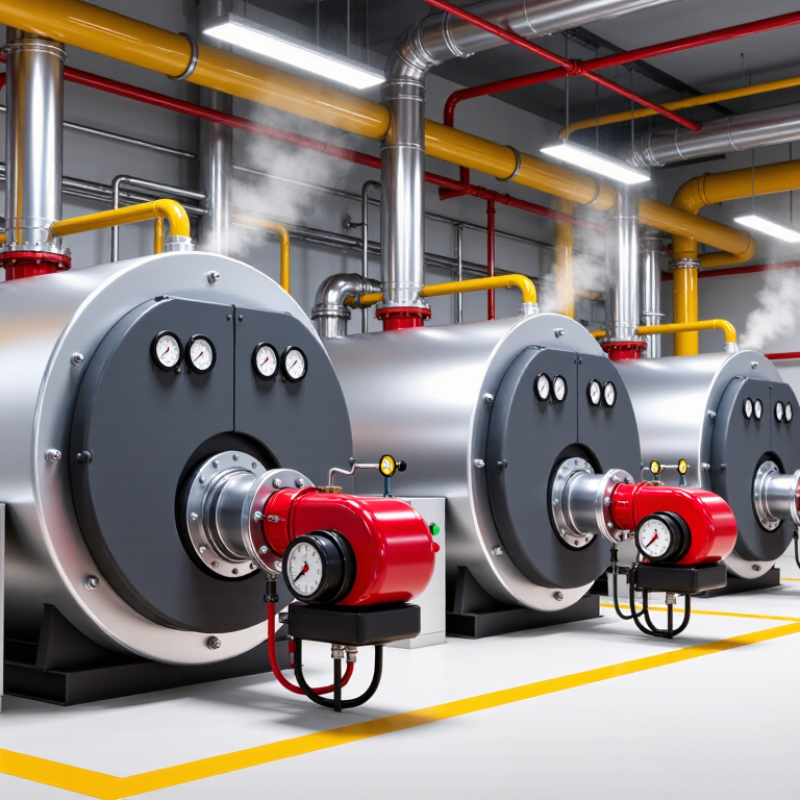
Natural-gas steam boilers burn fuel to heat water, producing steam for process equipment, building heat, or sanitation. Their design commonly includes a burner, pressure vessel, controls, and safety devices. Burner settings affect fuel use and steam output, while insulation helps limit heat loss. A steady blue flame is a useful visual clue, but it cannot replace proper combustion checks.
Small details matter.
These boilers serve laundries, food plants, hospitals, and manufacturing sites where dependable steam is needed. The right capacity depends on peak demand, operating hours, return-water temperature, and pressure requirements. Oversizing can lead to frequent cycling and wasted fuel; undersizing may leave equipment short of steam during busy periods.
Actual performance varies with maintenance and site conditions. A neat specification sheet rarely captures every load swing.
Tips:
Record fuel use and steam demand over representative operating days. Check for leaks, damaged insulation, unusual burner noise, and changing pressure. Have qualified technicians inspect combustion and safety controls according to the equipment manual. Keep maintenance records.
Not always easy. A short log can still reveal patterns, though readings should be checked for accuracy.
When comparing natural gas steam boiler manufacturers in 2026, look beyond advertised efficiency. Ask for performance data at the loads your facility actually uses, not just at peak output. A boiler serving a hospital has different demands from one heating a small workshop. Check turndown range, steam pressure stability, fuel consumption, and emissions documentation. Request independent test records where available. Confirm that the proposed controls can connect with your existing equipment. Small details matter, such as how quickly the unit responds to changing demand.
Tips: Ask for references from installations with similar operating hours and steam needs. Speak with the site operator, not only the sales team. Check parts availability and local service response times before signing.
Evaluate the manufacturer’s engineering support, operator training, warranty terms, and maintenance guidance. Clear drawings and accessible manuals can save hours during commissioning. Review the safety documentation and verify that the equipment meets applicable local requirements. Ask how the manufacturer handles software updates and replacement components over the boiler’s expected service life. A polished brochure is not proof of reliable support. I would still question any claim that lacks measurable evidence. Even strong manufacturers may have service gaps in some regions, so confirm who will answer the call when the boiler stops producing steam.
Use this weighted framework to compare manufacturers for a specific project. The weights are suggested evaluation priorities, not an official ranking. Verify requirements against the applicable local codes, project specification, and operating conditions.
| Evaluation Criterion | Suggested Weight | What to Evaluate | Evidence to Request |
|---|---|---|---|
| Code compliance and pressure-vessel documentation | 15% | Confirm that the boiler design, construction, inspection, and documentation meet the codes and jurisdictional requirements for its intended service. In the United States, ASME BPVC Section I generally covers power boilers, while Section IV covers heating boilers; applicability depends on the equipment and installation. | Applicable code stamps or certifications, inspection records, nameplate details, and a written statement identifying the governing code and jurisdiction. |
| Capacity and operating-pressure fit | 12% | Check rated steam output and allowable operating pressure against the actual load profile, peak demand, turndown needs, and system design. Compare ratings using consistent units and stated operating conditions. | Certified rating data, pressure limits, capacity tables, and performance information across the expected load range. |
| Fuel and burner compatibility | 12% | Verify compatibility with the site’s natural-gas supply pressure and fuel specification. Where required, confirm whether the burner supports a specified alternate fuel and what conversion or additional equipment would be needed. | Burner data, permitted fuel specifications, required gas pressure and flow, and any documented conversion requirements. |
| Thermal efficiency and test basis | 12% | Compare efficiency figures only when the calculation method, fuel heating-value basis (HHV or LHV), steam conditions, feedwater temperature, and operating load are stated consistently. Consider expected part-load operation as well as full-load ratings. | Test reports or clearly defined performance guarantees showing the test method, assumptions, and operating conditions. |
| Emissions and permitting suitability | 10% | Assess emissions relevant to the site’s permit and local rules, including nitrogen oxides (NOx) and carbon monoxide (CO), where applicable. Limits and measurement conditions vary by jurisdiction, equipment, and operating conditions. | Emissions guarantees or test data that state pollutant units, reference oxygen or other correction basis, load, and test method. |
| Controls, safety, and system integration | 10% | Review burner management, water-level protection, alarms, interlocks, control functions, and interfaces with the plant control system. Confirm that the proposed configuration meets applicable safety requirements and the project’s operating philosophy. | Control and instrumentation drawings, functional descriptions, safety-device lists, and interface requirements. |
| Manufacturing quality and traceability | 8% | Evaluate documented quality controls, material traceability, welding procedures, inspection processes, and nonconformance handling. An ISO 9001 quality-management-system certificate is evidence of a management system, not by itself proof that a particular boiler design complies with product codes. | Current quality-system certificates where applicable, inspection and test plans, material records, and manufacturing quality documentation. |
| Service, parts, and technical support | 8% | Check local service coverage, support availability, spare-parts lead times, commissioning scope, and the availability of qualified technicians. Evaluate the service arrangement for the full expected operating life. | Service response commitments, parts lists and availability information, commissioning plan, and training options. |
| Maintenance and lifecycle cost | 7% | Compare expected fuel use, routine maintenance, consumables, inspection needs, and likely downtime over a consistent analysis period. Include assumptions such as annual operating hours, load profile, and energy prices. | Itemized maintenance schedule, recommended spare parts, warranty terms, and lifecycle-cost assumptions. |
| Delivery, installation, and project execution | 6% | Assess the proposed delivery schedule, installation responsibilities, site access and utility requirements, commissioning sequence, and coordination with other contractors. | Project schedule, scope-of-supply matrix, site requirements, commissioning plan, and a list of customer-provided services. |
| Total Suggested Weight | 100% | Score each criterion using the same evidence standard for every bidder, then apply the weights to the project’s priorities. | |
Leading natural gas steam boiler manufacturers differentiate themselves through product range, not just rated output. Their catalogues commonly include compact fire-tube packages for smaller plants, water-tube units for higher steam demand, and modular systems that let operators stage boilers as loads change. Look for practical details: accessible burner assemblies, clear water-level controls, and turndown performance that suits the site’s real load. A large nameplate rating alone proves little.
The U.S. Department of Energy’s Improving Steam System Performance sourcebook notes that steam systems can account for a substantial share of industrial energy use; its guidance emphasizes system-level assessment, not boiler efficiency in isolation. That distinction matters. Compare published efficiency conditions, emissions data, maintenance intervals, and control features across manufacturers. Ask for performance references from facilities with similar pressure, fuel quality, and operating hours. Product brochures rarely show every site constraint. That is worth remembering.
Tips: Request a written load profile before comparing proposals. Check whether the quoted package includes the burner, feedwater equipment, controls, and commissioning. A slightly imperfect question is useful: “What happens when demand suddenly drops?” The answer can reveal whether the selected boiler will cycle excessively or operate smoothly.
Illustrative comparison of the direct CO₂ emissions associated with producing 1 MWh of useful heat at different boiler thermal efficiencies.
Values are calculated using the U.S. EPA natural gas combustion factor of 53.06 kg CO₂ per MMBtu and 3.412 MMBtu per MWh. Higher efficiency reduces fuel use and direct emissions for the same useful heat output. These are illustrative efficiency scenarios, not manufacturer-specific product ratings; upstream emissions are excluded.
When comparing natural gas steam boiler manufacturers, start with usable capacity at your actual operating pressure, not the largest number on a brochure. A food plant running two shifts may need stable low-load operation as much as peak output. Ask for tested efficiency at several firing rates, and clarify whether figures include standby losses. A polished rating can still hide a poor fit.
Emissions deserve the same scrutiny. The U.S. Energy Information Administration lists natural gas combustion at about 52.91 kg of CO₂ per million Btu; fuel use therefore matters alongside burner controls. Request emissions data at expected loads, including nitrogen oxides, and check which test conditions produced the figures. The U.S. Department of Energy’s Improving Steam System Performance sourcebook also highlights condensate return and steam-system management as ways to reduce fuel demand. Boiler performance is only part of the picture.
Tip: Compare service response times, technician coverage, spare-parts availability, and commissioning support in writing. Ask for references from facilities with similar steam loads. One weakness in many comparisons: maintenance costs are often treated as an afterthought, though a delayed repair can interrupt production.
Natural gas steam boiler manufacturing is moving beyond burner output. Buyers increasingly expect lower emissions, stable steam pressure, and clear operating data. The U.S. Department of Energy’s 2022 Industrial Decarbonization Roadmap reports that process heating accounts for about 51% of manufacturing energy use. That scale makes small efficiency gains meaningful. It also raises the bar for boiler makers.
Design changes are becoming practical, not cosmetic. Manufacturers are integrating oxygen-trim controls, exhaust-gas economizers, and modular burners that match fluctuating loads. Better sensors can expose short cycling in a plant’s daily logs. The IEA’s Gas 2024 report projected global gas demand growth of 2.5% in 2024, reinforcing the need for dependable gas-fired equipment during the transition. Yet demand alone does not justify a larger boiler. Oversizing still wastes fuel, and control upgrades cannot fix poor system design.
Procurement is shifting toward measurable performance: turndown range, startup time, maintenance access, and verified emissions data. Some facilities are pairing gas boilers with electric boilers or heat recovery, especially where steam demand changes by shift. This complicates engineering. It can also reduce fuel use when integration is done well. Manufacturers that document tested efficiency across realistic loads may earn more trust than those relying on headline ratings. There is still a gap between laboratory figures and a dusty, hard-working boiler room. That deserves more attention.
Watch video