Top Football Ball Launcher Machine Manufacturers?

Choosing a Football Ball Launcher Machine is not just a matter of comparing firing speed. Coaches need predictable delivery, useful range, and controls that suit the age and skill of their players. A ball arriving at waist height feels very different from one skimming across wet grass. Small details matter.

Physicist Isaac Newton wrote, “For every action, there is an equal and opposite reaction.” His principle helps explain why launch angle, wheel speed, and ball condition affect a machine’s delivery. It is not a football-equipment endorsement, but it is a useful reminder: consistent results depend on several interacting parts. Buyers should look for clear specifications, practical demonstrations, and responsive after-sales support—not just bold claims.

This guide compares leading manufacturers by design, adjustability, portability, and service information. It also considers the realities of training: setup time, power needs, storage, and how easily staff can change drills. A machine may look impressive in a catalogue. The test is whether it delivers repeatable passes on an ordinary training ground, with real balls and changing conditions. No single model suits every club. And specifications can leave questions unanswered. Verify them with the manufacturer before purchasing.
Top Football Ball Launcher Machine Manufacturers?

What Is a Football Ball Launcher Machine?

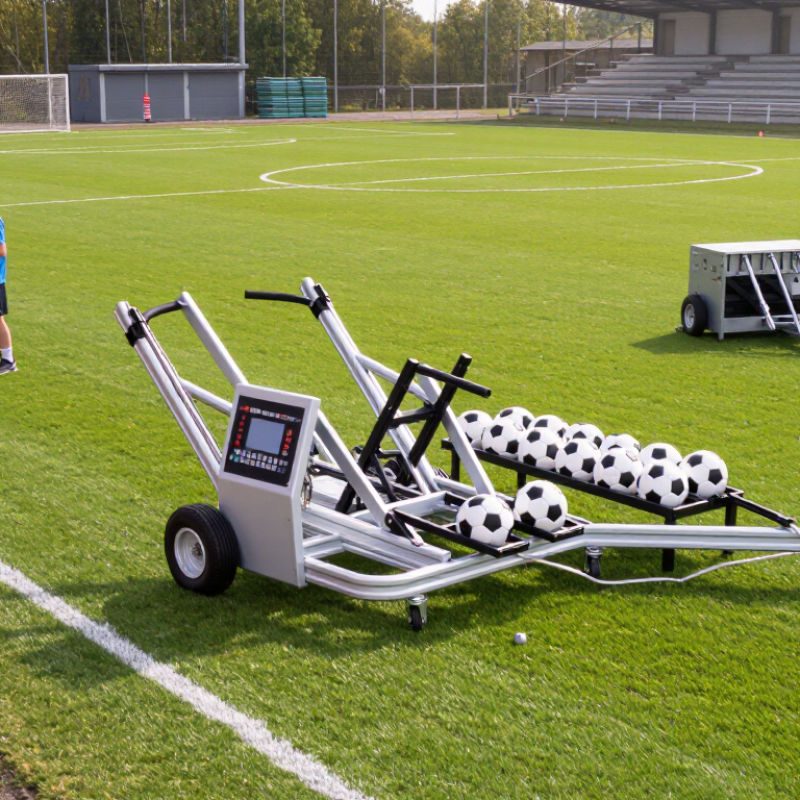
A football ball launcher machine is a training device that propels footballs toward a player or target area. Depending on its design, it may use rotating wheels or another powered mechanism to control ball speed and direction. Adjustable launch angles and intervals can help coaches practise receiving, passing, and goalkeeping under repeatable conditions. Some machines also feed balls automatically, reducing time spent collecting and resetting them.

Tips: Check that the machine accepts your ball size. Start with a low speed and a clear landing zone. Keep players outside the launch path.

The useful feature is consistency, not perfect realism. A steady stream of balls can help players repeat a drill, but match situations are less predictable. Uneven balls, different inflation levels, or a poorly chosen angle may change the delivery. Check the setup before each session, and adjust it to players’ age and skill. A setting that seems accurate on an empty field may feel too fast once players are moving. That detail is easy to overlook. Coaches should supervise operation and follow the equipment maker’s safety instructions.

How Football Ball Launchers Support Training

How Football Ball Launchers Support Training

A football ball launcher gives coaches a repeatable way to deliver crosses, ground passes, and shots during focused drills. Players can practice receiving under pressure without relying on a teammate to serve every ball. The difference is practical. Less time collecting balls means more repetitions within a session.

For example, a coach can place cones near the penalty area and set the launcher to send balls across the box at varied angles. One player attacks the near post, while another waits centrally for a second ball. Changing the delivery height and pace can help players work on first touches, volleys, and defensive clearances. Keep the settings suitable for the group’s age and ability. Fast delivery is not automatically better.

These machines can also help goalkeepers repeat positioning drills, but they cannot read the game or replace live decisions. Coaches still need to watch footwork, communication, and fatigue. A launcher may send a consistent ball, yet real matches are messy. That limitation matters. Use it to build technique, then add defenders and changing scenarios so practice remains connected to the game.

Top Football Ball Launcher Machine Manufacturers? - How Football Ball Launchers Support Training

Manufacturer-neutral comparison of common football launcher configurations and the training tasks they can support. Features and performance vary by model; confirm specifications with the supplier before purchase.

Launcher configuration Typical delivery setup Useful adjustments to check Training support Purchasing checks
Single-ball launcher One ball is loaded and launched at a time. Launch direction, elevation, speed, and interval, where supported. Repetitive passing, first-touch practice, and goalkeeper reaction drills. Check loading time, remote controls, ball compatibility, and operator safety guidance.
Hopper-fed launcher A hopper or feeder holds multiple balls for repeated delivery. Feed rate, launch interval, trajectory, and direction, depending on the model. High-repetition drills with fewer pauses to reload between launches. Verify stated hopper capacity, feed reliability, ball spacing, and clearing procedure.
Adjustable-angle launcher The launch angle can be changed to produce different ball trajectories. Elevation and, if available, speed and spin. Ground passes, driven balls, and aerial-ball control practice. Ask for the documented adjustment range and whether settings are repeatable.
Oscillating or directional launcher The launch direction changes across a fixed or adjustable sweep. Sweep angle, direction sequence, and launch timing, if provided. Movement, scanning, reaction, and receiving drills that require players to adjust to changing delivery directions. Check sweep limits, cycle settings, stability, and whether the unit can be operated safely from the training area.
Programmable launcher Controls may allow users to set or repeat delivery sequences. Sequence, interval, speed, angle, or direction, according to the supplied controls. Structured passing, finishing, and goalkeeper sessions with repeatable delivery patterns. Request a demonstration of the programming interface, saved settings, and emergency-stop operation.
Portable training unit A compact or wheeled unit intended to be moved between practice locations. Setup position, launch direction, and available power options. Flexible small-group or multi-station practice where equipment needs to be repositioned. Check overall dimensions, transport method, power requirements, and setup time.

Specifications to compare across manufacturers

Specification Why it matters What to verify
Ball size and type A launcher’s feed and delivery system must suit the footballs used in training. Supported ball sizes, construction, pressure guidance, and any restrictions on worn or wet balls.
Speed and trajectory range Delivery settings affect the difficulty and suitability of a drill. Published operating range, measurement method, and whether speed changes with ball type or launch angle.
Power and operating time Power access determines where and how long the machine can be used. Mains or battery requirements, charging time, stated operating time, and outdoor-use limitations.
Safety and support Clear operating procedures help coaches manage repeated launches and moving parts. Emergency stop, guarding, operator instructions, maintenance schedule, warranty, and service availability.

Note: The configurations above describe general equipment types, not the verified specifications of individual manufacturers or models.

Key Factors for Evaluating Football Launcher Manufacturers

When comparing football ball launcher manufacturers, look beyond headline speed and advertised range. A useful machine should deliver repeatable passes across short, medium, and long settings, with predictable changes in launch angle. Ask for test data showing ball type, pressure, distance, and shot-to-shot variation. Numbers need context. That detail helps distinguish controlled performance from a polished demonstration.

Check the feed system, motor design, and adjustment controls. During a trial, watch whether balls feed cleanly after repeated launches and whether settings remain stable on uneven training surfaces. Small faults matter. A jam every few dozen balls can interrupt a session more than a modest reduction in top speed. Inspect guards, emergency-stop access, cable routing, and frame stability before purchase.

Manufacturer support deserves equal scrutiny. Request a clear warranty, spare-parts list, maintenance schedule, and realistic response times for technical questions. Ask how calibration is handled and whether staff can explain safe setup to coaches. A low price can hide expensive downtime. Do not rely on a brochure alone; a supervised demonstration with your own footballs can reveal fit, noise, and control issues. Even then, keep notes. A rushed test is imperfect.

Leading Football Ball Launcher Machine Manufacturers

Leading football ball launcher machine manufacturers distinguish themselves through dependable engineering, not flashy speed claims. A well-designed unit should deliver repeatable passes across adjustable distances and trajectories. Coaches can test this by recording launch direction and landing points during repeated sessions. Consistency matters. A few stray balls can disrupt a drill.

Manufacturers with practical experience consider the full training environment. Look for clear controls, stable wheels, guarded moving parts, and settings that staff can change without stopping practice for long. The feeder should handle common ball sizes without frequent jams. Ask how the machine performs with damp or worn balls, and how often rollers need inspection. Small maintenance details matter. They are easy to overlook.

A reliable supplier also provides usable setup instructions, spare-part access, and responsive technical support. Ask for a demonstration with the drills your team actually runs, rather than relying only on a product sheet. Compare battery runtime, loading capacity, transport weight, and available adjustment ranges. No machine fits every field. Some specifications may look impressive but prove awkward during a busy session, so leave room for hands-on evaluation.

Top Football Ball Launcher Machine Manufacturers: Ball-Size Compatibility

Launcher machines need to accommodate the circumference of the balls they are designed to feed. These common size ranges provide a practical compatibility reference; confirm supported ball sizes with each manufacturer.

Ball circumference ranges shown in centimeters, converted from common size 3, 4, and 5 specifications.

How to Compare Manufacturers and Choose a Supplier

When comparing football ball launcher machine manufacturers, look beyond maximum speed. A high top speed means little if the machine struggles to repeat the same pass. Ask how feed rate, launch angle, and spin can be adjusted, and whether settings remain consistent during longer sessions. Request a live demonstration using the ball sizes and training drills you actually use. Watch the first few launches, then watch again after several minutes. Small variations matter.

Check how clearly the supplier documents testing, maintenance, and expected wear. Ask which parts need routine inspection, how quickly replacements can be supplied, and what training comes with delivery. A compact machine may suit a crowded training ground, while a larger unit could offer easier loading or a broader adjustment range. Compare the footprint, power requirements, safety features, and warranty terms in writing.

Details count.

Supplier support deserves the same attention as machine performance. Ask for references from organizations with similar workloads, and speak with users about response times, setup, and repairs. A polished brochure cannot answer everything. I would not treat one successful demonstration as proof of long-term reliability; it is only one data point. Compare several suppliers against the same checklist, and note any answer that remains vague.

Smart Robotics brand movie

Watch video