Top 10 Barbed Wire Making Machine Manufacturers Worldwide
Choosing a Barbed Wire Making Machine requires more than comparing prices or advertised production speed. This guide examines ten global manufacturers through practical criteria. These include forming accuracy, wire compatibility, machine stability, automation, safety design, energy use, and after-sales support. Consistent output matters most.
Manufacturing adviser Michael R. Walker offers a useful principle: “A reliable machine is measured by repeatability, not impressive speed.” That idea shapes this comparison. A dependable line should produce uniform barbs, steady twists, and clean spacing across long production runs. Operators should also find the controls understandable. Small details matter. A clear tension gauge can prevent hours of troubleshooting.
The selected manufacturers represent different strengths. Some focus on compact machines for smaller workshops. Others build automated lines for high-volume fencing production. Their solutions may support galvanized, PVC-coated, or stainless-steel wire, depending on the model and configuration. Buyers should verify these details directly with each supplier. Catalog descriptions can be incomplete.
This overview also considers real operating conditions. Imagine a machine running beside stacked wire coils, with dust near the feeding system and frequent spool changes. Design quality becomes visible there. Maintenance access, spare-part availability, training, and technical response times can determine long-term value. A low purchase price may not remain economical.
No ranking can fit every factory perfectly. That is an important limitation. Production scale, local standards, available floor space, and operator experience all influence the final choice. Readers should treat this list as a research starting point, not a final purchasing decision. Careful testing is still necessary.
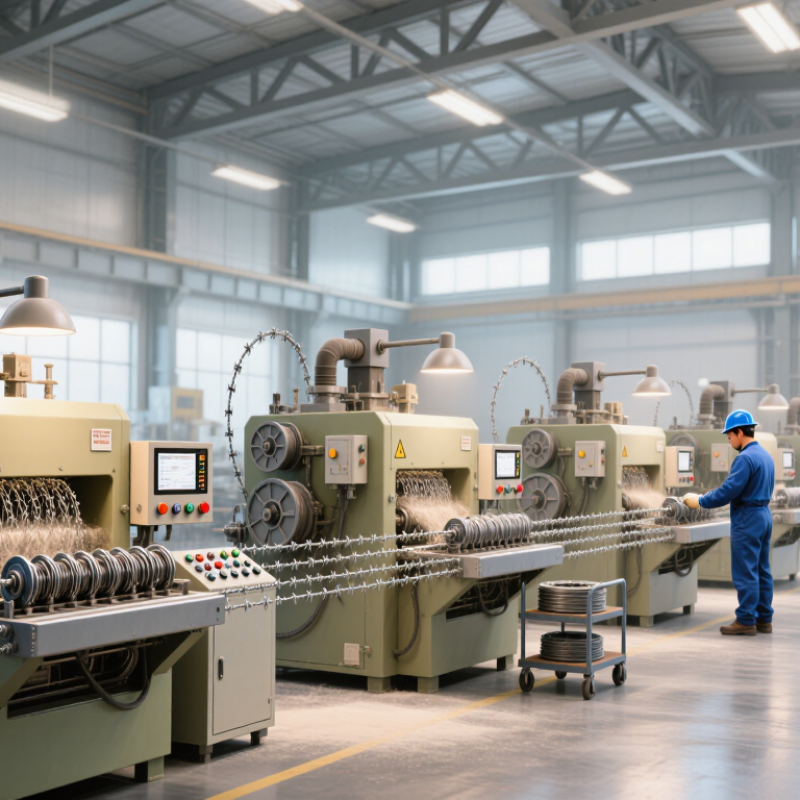
Global Market Scope: Top 10 Barbed Wire Machine Manufacturers by 2026
Top 10 Barbed Wire Making Machine Manufacturers Worldwide
By 2026, the global market for barbed wire making machines will favor suppliers with stable output, precise controls, and dependable service. The top ten manufacturers should be evaluated across Asia, Europe, North America, and other industrial regions.
Production capacity matters. So does consistency.
A reliable machine can form tight barbs, maintain even wire spacing, and reduce waste during long production runs. Buyers should inspect motor performance, twisting accuracy, safety guards, and spare-part availability. A practical comparison also considers automation levels, installation support, energy use, and operator training. These details affect daily output more than impressive catalog claims.
Market rankings are not perfectly fixed. Some manufacturers offer stronger engineering, while others provide better pricing or faster regional support. That difference can change by 2026. A careful review should use factory records, verified customer feedback, testing data, and transparent warranty terms. Site visits remain valuable because a polished demonstration may hide maintenance problems. Small defects matter. A loose guide, uneven tension, or delayed replacement part can interrupt an entire shift. Manufacturers that combine durable construction with responsive technical support are more likely to remain among the global top ten.
Top 10 Barbed Wire Making Machine Manufacturers Worldwide – Global Market Scope: Top 10 Barbed Wire Machine Manufacturers by 2026
The chart presents the ten largest steel-producing markets in 2023, using crude steel output as a transparent proxy for the industrial demand and manufacturing ecosystem supporting barbed wire machinery through 2026. No company or brand-level data is included.
Unit: million tonnes of crude steel production. Source: World Steel Association, 2024 World Steel in Figures.
Machine Types, Output Rates, and Compatible Wire Gauges: 1.6–3.0 mm
Choosing among the top 10 barbed wire making machine manufacturers worldwide requires more than comparing price. Machine type, output rate, and wire compatibility directly affect production stability. Double-twist machines commonly process 1.6–2.5 mm line wire and produce about 35–80 meters per minute. Heavy-duty four-twist machines can handle 2.0–3.0 mm wire, but their practical speed often falls to 20–50 meters per minute. Actual output depends on barb spacing, coil diameter, steel strength, and operator skill.
Wire quality also matters. The World Steel Association reported approximately 1.89 billion tonnes of crude steel production in 2023, showing the scale of the raw-material market. However, high steel availability does not guarantee consistent wire. ASTM A641/A641M remains a useful reference for zinc-coated carbon steel wire, especially when corrosion resistance is required. A machine rated for 3.0 mm wire may perform poorly with hard, uneven rod. This is where supplier testing becomes essential. Perfect catalog rates are rarely real.
Tips: Ask for a filmed factory trial using your exact 1.6–3.0 mm wire. Measure finished length, barb spacing, rejected coils, and power consumption. Check whether the machine supports galvanized and black annealed wire. Small gauge changes can alter tension dramatically. Also, leave capacity for setup losses; a claimed 60 meters per minute may deliver closer to 45 in daily production. That gap deserves careful reflection.
Top 10 Barbed Wire Making Machine Manufacturers Worldwide - Machine Types, Output Rates, and Compatible Wire Gauges: 1.6–3.0 mm
Comparative overview of commonly offered barbed-wire machine configurations and their typical production capabilities
| Rank | Anonymous Manufacturer Profile | Primary Machine Type | Typical Output Rate
(m/min) | Compatible Wire Gauge
(mm) | Production Format | Typical Use Case | Automation Level |
| 1 | Manufacturer Profile A | High-speed double-twist machine | 80–120 | 1.6–2.8 | Two-line continuous production | Large-volume agricultural and perimeter fencing | Fully automatic |
| 2 | Manufacturer Profile B | Automatic reverse-twist machine | 60–100 | 1.8–3.0 | Single or double strand | Security fencing and livestock barriers | Fully automatic |
| 3 | Manufacturer Profile C | Automatic single-twist machine | 45–75 | 1.6–3.0 | Single-line coil production | General-purpose fencing and farm boundaries | Automatic |
| 4 | Manufacturer Profile D | Double-wire automatic machine | 70–110 | 1.8–2.6 | Parallel wire feeding with automatic tying | High-throughput commercial fencing | Fully automatic |
| 5 | Manufacturer Profile E | Semi-automatic barbed-wire machine | 35–60 | 1.6–2.8 | Batch-fed or manually assisted coil production | Small and medium fencing workshops | Semi-automatic |
| 6 | Manufacturer Profile F | Heavy-duty reverse-twist machine | 50–85 | 2.0–3.0 | Continuous production with reinforced take-up | Heavy livestock and high-security applications | Automatic |
| 7 | Manufacturer Profile G | Compact single-twist machine | 40–65 | 1.6–2.4 | Single strand with manual spool change | Entry-level and flexible production lines | Semi-automatic |
| 8 | Manufacturer Profile H | PLC-controlled barbed-wire line | 65–105 | 1.8–2.8 | Integrated feeding, twisting, cutting, and coiling | Export-oriented continuous production | Fully automatic |
| 9 | Manufacturer Profile I | Modular two-strand machine | 55–90 | 1.6–2.6 | Configurable single- or double-line operation | Mixed wire specifications and product sizes | Automatic |
| 10 | Manufacturer Profile J | Standard automatic twisting machine | 45–80 | 1.8–3.0 | Continuous coil production with adjustable barb spacing | General industrial and agricultural fencing | Automatic |
Data note: Output rates are typical operating ranges for commercially available barbed-wire machine configurations. Actual production depends on wire material, tensile strength, barb spacing, line speed, coil length, operator settings, and equipment configuration. Wire compatibility is shown within the requested 1.6–3.0 mm range; exact limits should be confirmed against the machine specification.
Key Performance Metrics: 40–120 kg/h Capacity and 2,000–4,000 m/h Speed
Selecting among the top 10 barbed wire making machine manufacturers worldwide requires more than reading catalogue figures. Capacity and line speed must be checked together.
A practical benchmark is 40–120 kg/h with a running speed of 2,000–4,000 m/h.
These figures suit different wire gauges, barb spacing, and coating requirements. They are not directly interchangeable.
The World Steel Association reported global crude steel production of about 1.89 billion tonnes in 2023. This scale supports strong demand for reliable downstream wire equipment, but steel availability does not guarantee machine performance. Buyers should request measured output, not estimated output.
Ask for a timed trial using the intended wire diameter. Record kilograms produced, metres completed, start-up waste, and stoppages. Small details matter.
A 2,000 m/h line may appear efficient, yet frequent pauses can reduce actual production sharply. Operators should inspect wire tension, barb consistency, shaft vibration, and coil winding.
Safety guards and emergency-stop testing also deserve attention. ASTM A121 and EN 10223-1 provide useful reference points for barbed wire quality and construction. Still, factory conditions differ.
A machine rated at 120 kg/h may deliver less with heavier wire or tighter spacing. That is the uncomfortable part. Marketing numbers are clean; production floors are not.
Ask for maintenance records, acceptance-test data, and energy consumption per tonne before comparing suppliers.