What Are the Top Auto Shaft Types in 2026?
Auto Shaft selection in 2026 reflects two forces: global vehicle production and changing powertrain designs. OICA reported 93.5 million motor vehicles produced worldwide in 2023, a useful measure of the industry’s manufacturing scale. The International Energy Agency’s Global EV Outlook 2024 projected electric-car sales would reach about 17 million that year, exceeding one in five cars sold globally. These figures do not predict shaft demand directly. They show why engineers and buyers must consider both volume and vehicle architecture.
The main types serve different jobs. Drive shafts carry torque from the transmission or differential to the wheels. Axle shafts connect the differential to driven wheels, while steering shafts transmit driver input through the steering system. Engine designs also use crankshafts and camshafts, each with distinct motion and load requirements. Materials, joint design, length, and operating speed affect performance. A shaft suited to a rear-wheel-drive pickup may not suit a compact electric vehicle.
That distinction matters. For 2026, this guide compares common Auto Shaft types by function, configuration, and typical application. It also considers how electrification changes component layouts, without assuming every electric vehicle uses the same design. One caution: market reports often group components differently, so published market-size estimates can be hard to compare. Vehicle specifications and manufacturer documentation remain essential checks when choosing a shaft. A label alone is not enough.
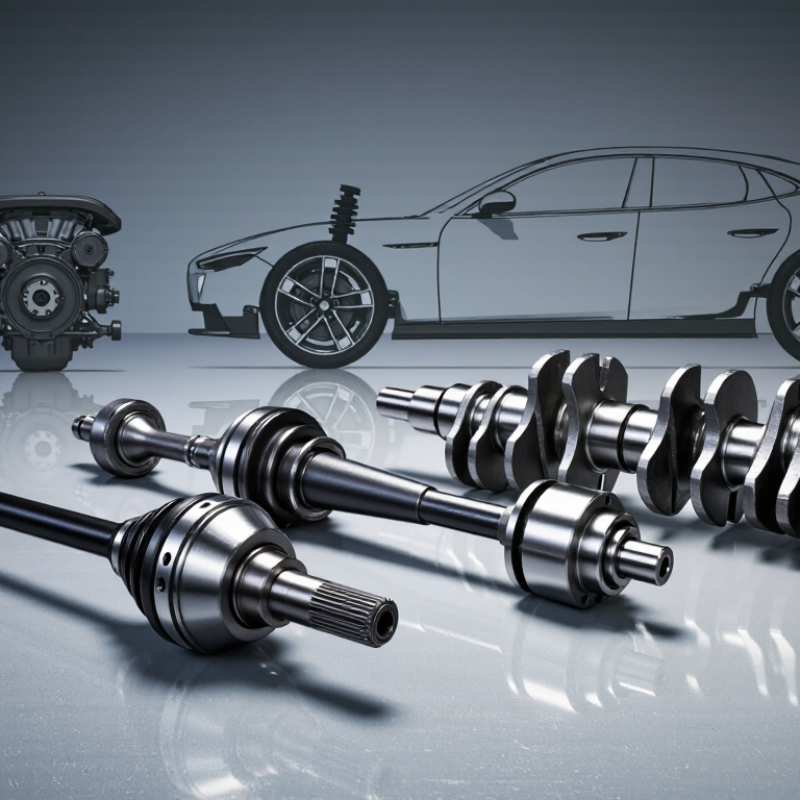
Table of Contents [Hide]
How Automotive Shafts Transfer Motion and Torque
An automotive shaft does more than spin. It carries torque between components while tolerating vibration, heat, and changing loads. The crankshaft turns piston motion into rotation; transmission input and output shafts carry that rotation through selected gear ratios. A propeller shaft then sends torque toward the differential, while half-shafts deliver it to the wheels. Small parts. Heavy work.
The details change with the drivetrain. A rear-wheel-drive propeller shaft may be long and hollow to reduce mass, while a front-drive half-shaft needs joints that follow steering and suspension movement. Electric vehicles still use shafts, though their torque paths differ. The IEA’s Global EV Outlook 2024 reports nearly 14 million electric-car sales in 2023, about 18% of global car sales. That shift makes shaft design increasingly varied, not obsolete. Engineers must account for peak torque, shaft angle, fatigue, and packaging—not just rated power. A clean diagram can make this look simple. Real roads are less tidy, and small alignment errors can matter.
Customers




Smart Robotics brand movie
Watch video