China’s Welded Steel Pipe industry supports construction, energy, water treatment, machinery, and infrastructure projects worldwide. This guide introduces ten notable manufacturers and explains why buyers may consider them for demanding applications. Each company is assessed through practical purchasing factors, not advertising claims alone.
Our review considers production capacity, pipe dimensions, steel grades, welding methods, surface treatment, and quality-control procedures. It also examines certifications, testing records, export experience, and communication during order fulfillment. A reliable manufacturer should provide traceable material certificates and clear inspection reports. Factory visits, sample testing, and third-party verification remain valuable when project risks are high.
Details matter.
For example, buyers may compare spiral welded pipe and longitudinal welded pipe for different pressure, diameter, and installation requirements. They should also confirm tolerance standards, coating thickness, packaging strength, and delivery schedules before signing contracts. A strong supplier can explain these choices without hiding technical limitations.
Still, no ranking is permanently correct. Market conditions change, equipment upgrades take time, and customer experiences may differ between projects. Some manufacturers may excel in large infrastructure orders but offer less flexibility for small batches. Others may provide excellent customization while having longer production schedules. This article therefore serves as a practical starting point, not a final purchasing decision.
Readers should match each Welded Steel Pipe manufacturer with their project specifications, local regulations, budget, and inspection requirements. Careful verification often reveals more than a polished company profile.
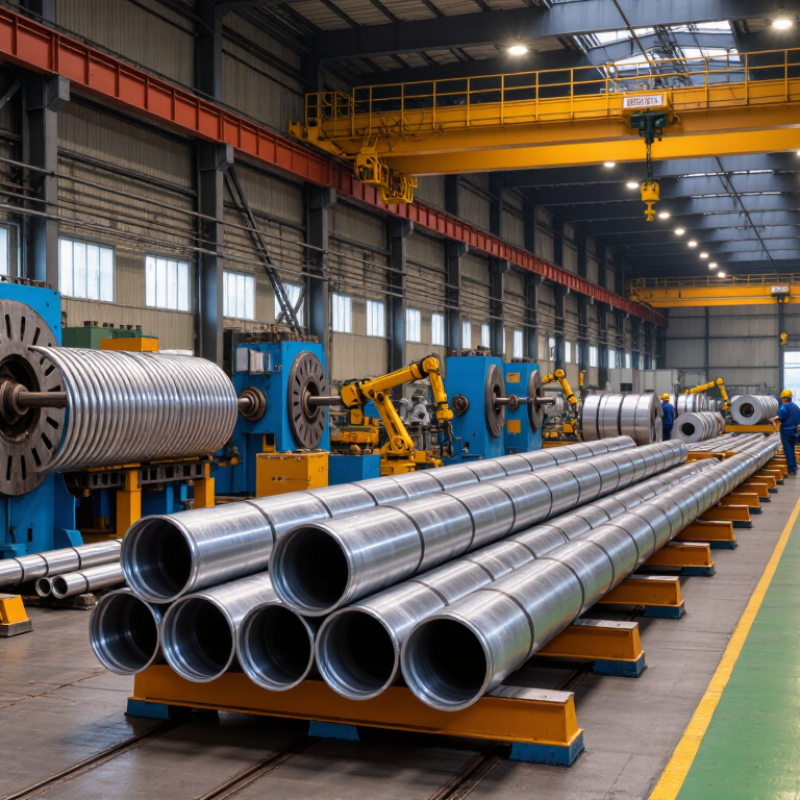
Welded steel pipe manufacturing covers more than forming and joining steel strip. It includes material selection, edge preparation, welding, sizing, testing, coating, and traceability. Common production routes include electric resistance welding, high-frequency welding, and spiral submerged arc welding. Each route suits different diameters, wall thicknesses, and service conditions.
The World Steel Association reported that China produced 1,019.1 million tonnes of crude steel in 2023. This large raw-material base supports an extensive pipe manufacturing sector. However, crude steel output does not equal finished welded pipe output. That distinction matters when comparing manufacturers, capacity, or export performance.
In practical production, coils are uncoiled, leveled, and shaped before welding. Operators then inspect weld seams using ultrasonic or radiographic methods, depending on project requirements. Dimensional checks examine outside diameter, wall thickness, ovality, and straightness. Surface coatings may include protective systems for buried, marine, or industrial environments.
China’s manufacturing scope also includes pipes made under national, international, and customer-specific standards. Relevant specifications can define chemical composition, mechanical strength, weld acceptance, hydrostatic testing, and marking. The International Energy Agency’s World Energy Investment 2024 report highlights continuing infrastructure investment, but demand forecasts remain uneven across regions. Capacity can therefore look impressive while utilization stays inconsistent.
The boundary is not always clean. Some suppliers emphasize trading volume rather than controlled manufacturing. Buyers should verify mill certificates, heat numbers, inspection records, and production-line capability before ranking any producer. A polished catalog is not proof.
China’s welded steel pipe industry has changed from volume-driven production to quality-focused manufacturing. Early mills often relied on basic forming lines and manual inspection. Today, leading manufacturers use high-frequency welding, submerged arc welding, and automated ultrasonic testing. These methods improve seam consistency and reduce hidden defects.
The top 10 manufacturers are usually evaluated through practical indicators, not production capacity alone. Engineers examine steel grade control, wall-thickness accuracy, weld strength, and delivery records. A modern factory may track each coil from chemical testing to final hydrostatic inspection. Large-diameter pipes require careful edge milling, pre-bending, and alignment before welding. Small errors can become serious problems during pressure service.
The industry also serves construction, energy, water transport, and machinery manufacturing. Domestic infrastructure projects have encouraged wider pipe sizes and stricter quality documentation. Export orders have pushed factories to understand international standards, coating systems, and third-party inspection procedures. Digital production records now support traceability, but data quality remains uneven. Some workshops still depend too heavily on operator experience. That is risky.
Environmental pressure is changing factory planning as well. Efficient furnaces, recycled cooling water, and lower-emission logistics can reduce operating costs. Yet cleaner equipment requires significant investment, especially for smaller producers. Skilled workers remain essential. Automation helps, but it cannot replace sound judgment when a weld profile looks abnormal. The sector has progressed quickly, although consistency is still the difficult part.
Selecting leading welded steel pipe manufacturers requires more than comparing prices. A reliable producer should show consistent weld quality, accurate dimensions, and stable production records. Factory experience matters, but documented performance matters more. Review quality certificates, inspection procedures, and test reports for each pipe batch. Check whether the manufacturer can provide traceability from steel coil to finished pipe. This detail becomes important when projects involve pressure, construction, or long-term service.
Production capability also deserves close attention. Visit the facility when possible. Observe welding lines, ultrasonic testing equipment, coating areas, and storage conditions. A serious manufacturer controls moisture, handling, and inventory labels. Ask about delivery capacity during busy periods. Communication is another practical test. Clear drawings, realistic lead times, and prompt technical answers often reveal operational discipline. I would not rank a supplier highly based on attractive catalog images alone. That approach can overlook weak inspection practices.
China’s leading welded steel pipe manufacturers serve construction, energy, water, machinery, and infrastructure projects. Their profiles differ in scale, specialization, and production discipline. Some operate large electric resistance welding lines for consistent wall thickness. Others focus on spiral welded pipes for water transmission and foundation work. A few combine pipe forming, heat treatment, coating, and inspection under one roof. This integration can shorten delivery time, but it does not automatically guarantee quality.
Reliable manufacturers usually disclose standards, testing methods, production capacity, and material traceability. Their facilities may include ultrasonic inspection, hydrostatic testing, dimensional checks, and calibrated laboratories. Experienced buyers should examine mill certificates, welding procedures, coating specifications, and previous project records. Site audits can reveal practical details, such as storage conditions and how pipe ends are protected. Small details matter. However, public profiles may present an ideal picture. Independent verification is still necessary, especially for critical pipelines or large orders.
Tips: Compare several manufacturers using the same technical checklist. Confirm steel grade, outside diameter, wall thickness, length tolerance, and inspection scope. Ask for recent test samples, not only brochures. Check whether production dates match the shipping schedule. A lower quotation may hide weaker coating, limited testing, or higher transport risk. I would also allow time for technical clarification. Rushed specifications often create avoidable disputes.
Typical commercial maximum outside diameters by welded-pipe manufacturing process. These industry benchmark figures provide product-range context without presenting company-specific or brand data.
Values are representative upper commercial ranges commonly associated with each process; actual product limits vary by mill equipment, steel grade, wall thickness, and applicable standards.
China’s top 10 welded steel pipe manufacturers typically produce ERW, LSAW, and SSAW pipes for demanding industrial projects. Their product ranges include carbon steel, galvanized steel, and corrosion-resistant pipe. Common sizes run from small water lines to large-diameter transmission pipe. Wall thickness, outside diameter, and coating options must match the project design.
Quality programs often reference API 5L, ASTM A53, ASTM A252, EN 10219, and ISO 9001 requirements. Experienced factories use ultrasonic testing, hydrostatic testing, visual inspection, and dimensional checks. Mill certificates should identify heat numbers, chemical composition, tensile strength, and test results. Traceability matters.
Applications include oil and gas transmission, water treatment, construction piling, fire protection, structural frames, and district heating. Export orders commonly reach Southeast Asia, the Middle East, Africa, Europe, and South America. Each market may require different certificates, packaging, marking, and customs documents. Pipes may travel in bundles with steel straps, end caps, and moisture protection.
A low price can hide weak inspection.
Real purchasing experience shows that technical communication prevents many problems. Confirm welding processes, coating thickness, bevel details, and loading limits before production. Even a trusted supplier can misunderstand a drawing. I would also review independent inspection records, because factory claims alone are not enough. Salt exposure, port handling, and long storage can damage unprotected pipe surfaces.
Anonymized comparison of representative Chinese welded steel pipe manufacturing profiles, based on commonly applied product standards and end-use sectors.
| No. | Manufacturer Profile | Primary Welded Pipe Products | Common Product Standards | Typical Applications | Common Export Markets |
|---|---|---|---|---|---|
| 01 | Large-Diameter Spiral-Welded Pipe Producer | SSAW pipe Water transmission pipe Structural pipe | API 5L ISO 3183 EN 10217-1 | Long-distance water pipelines, oil and gas gathering lines, piling, dredging, and large infrastructure projects. | Middle East, Southeast Asia, Central Asia, Africa, and Latin America. |
| 02 | Longitudinal Submerged-Arc Welded Pipe Producer | LSAW pipe JCOE pipe Heavy-wall pipe | API 5L ISO 3183 EN 10219 | High-pressure oil and gas transmission, offshore construction, bridge structures, and port engineering. | Europe, the Middle East, Southeast Asia, North Africa, and South America. |
| 03 | Electric Resistance Welded Pipe Producer | ERW pipe Black steel pipe Galvanized pipe | ASTM A53 API 5L EN 10217-1 | Water and gas distribution, fire sprinkler systems, mechanical tubing, fencing, and general construction. | Southeast Asia, South Asia, Africa, the Middle East, and Latin America. |
| 04 | Structural Hollow Section Producer | Square hollow section Rectangular hollow section Circular hollow section | ASTM A500 EN 10219 JIS G3466 | Steel buildings, warehouses, solar mounting systems, agricultural equipment, trailers, and architectural structures. | Europe, Australia, the Middle East, Southeast Asia, and North America. |
| 05 | Oil and Gas Line Pipe Producer | API line pipe HFW pipe SSAW line pipe | API 5L PSL1 API 5L PSL2 ISO 3183 | Crude oil, natural gas, refined-product pipelines, compressor stations, and pipeline terminals. | Central Asia, the Middle East, Africa, Southeast Asia, and Latin America. |
| 06 | Boiler and Pressure-Service Tube Producer | Welded boiler tube Heat-exchanger tube Carbon steel tube | ASTM A178 ASTM A214 EN 10305-2 | Boilers, heat exchangers, condensers, district heating systems, and industrial process equipment. | Asia-Pacific, the Middle East, Europe, Africa, and South America. |
| 07 | Galvanized Construction Pipe Producer | Hot-dip galvanized pipe Pre-galvanized tube Scaffolding tube | ASTM A53 EN 10255 BS 1387 | Scaffolding, handrails, greenhouse frames, water service lines, fencing, and light structural work. | Africa, Southeast Asia, the Middle East, Oceania, and Latin America. |
| 08 | Piling and Foundation Pipe Producer | Welded pipe piles Spiral piles Large-diameter casing | ASTM A252 EN 10219 ASTM A671 | Building foundations, marine structures, bridge piers, quay walls, cofferdams, and deep foundation works. | Coastal Asia, the Middle East, Africa, Europe, and North America. |
| 09 | Precision Mechanical Tube Producer | Cold-drawn welded tube Automotive tube Precision hollow section | EN 10305-2 ASTM A513 DIN 2393 | Automotive components, hydraulic cylinders, furniture, exercise equipment, machinery, and precision assemblies. | Europe, North America, Japan, South Korea, Southeast Asia, and Australia. |
| 10 | Stainless and Corrosion-Resistant Welded Pipe Producer | Stainless welded pipe Sanitary tube Decorative tube | ASTM A312 ASTM A554 EN 10217-7 | Food processing, chemical equipment, pharmaceutical plants, water treatment, architectural work, and petrochemicals. | Europe, North America, Southeast Asia, the Middle East, Australia, and South America. |
| Standards listed are commonly used references for welded steel pipe products. Actual availability, dimensions, steel grades, testing requirements, certifications, and export eligibility depend on the individual production line and purchase specification. | |||||
Watch video