China Top 10 Wrist Watch Manufacturers for Buyers?
China’s watch industry includes established brands, specialist factories, and suppliers focused on private-label production. For buyers, finding the right Wrist Watch manufacturer involves more than comparing catalog photos. Movement options, case materials, finishing quality, and production capacity all affect the final product. Small details matter.
This guide introduces ten Chinese manufacturers for buyers to research, with attention to their product focus and potential sourcing fit. The list is a starting point, not a definitive ranking; company capabilities and services can change. Some manufacturers may suit premium designs, while others may be better prepared for larger orders or customized models. Not every supplier fits.
Before requesting a quotation, prepare a clear specification. Include the target quantity, preferred movement, case dimensions, dial details, packaging needs, and expected delivery schedule. Ask how samples are made and inspected, and request recent product information that matches your requirements. Confirm key terms directly with the company, since online listings may be incomplete or outdated. A polished sample is useful, but it does not guarantee every production unit will match.
A careful comparison can help buyers identify promising partners and avoid assumptions based on price alone. Consider communication, customization limits, quality-control procedures, and the supplier’s ability to explain its process. This introduction cannot replace independent checks or physical sample review. Use it to narrow the field, ask sharper questions, and make a decision grounded in evidence rather than presentation.
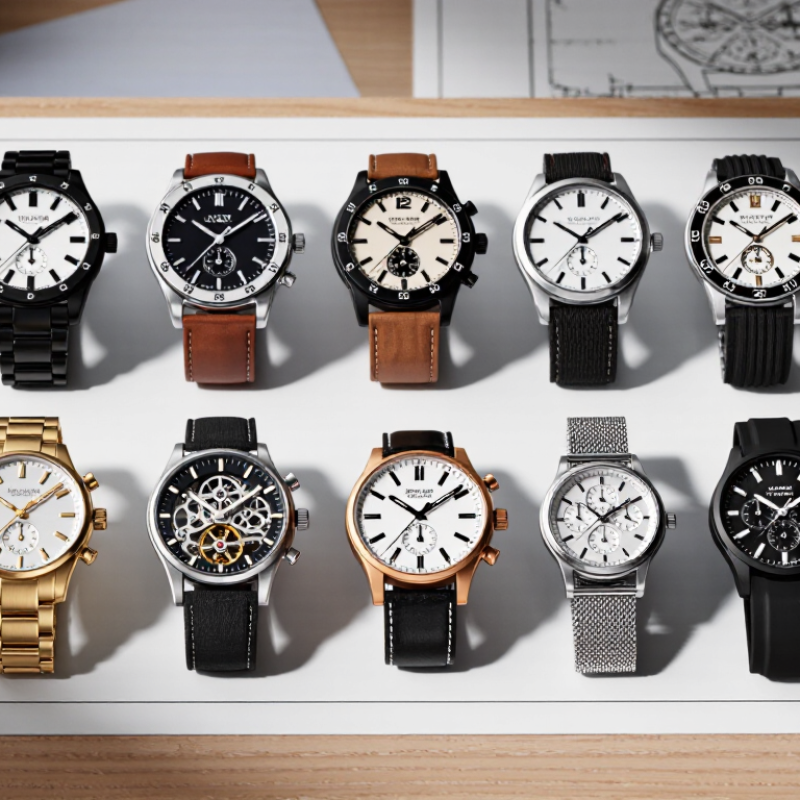
Define Wristwatch Types, Movements, and Buyer Requirements
Wristwatches differ in both purpose and construction. Analog models show time with hands, while digital displays use numerals; hybrid designs combine both. Dress watches are often slim, whereas sport or field styles may use larger cases and clearer markings. Movement matters, too. Quartz movements run on batteries and generally need little adjustment. Mechanical movements use wound springs, while automatic movements wind through the wearer’s motion. Each choice brings trade-offs in cost, servicing, and daily convenience. Small details matter.
Before requesting a factory quotation, define the buyer and the use case. Specify case diameter, thickness, preferred materials, dial layout, strap type, and target quantity. A watch for daily office wear may need a comfortable 38-millimeter case; outdoor use may call for stronger legibility and a clearly stated water-resistance rating. Ask how accuracy is tested, what inspection records are available, and whether sample approval happens before production. Ask for evidence. Also confirm packaging, lead time, replacement-part availability, and after-sales support in writing. A polished specification sheet can still miss a practical issue, such as a clasp that feels stiff after repeated use. I would not assume that “water-resistant” means suitable for every activity; clarify the intended conditions and test basis. No checklist catches everything, but clear requirements make supplier comparisons more useful.
Frame China’s Watch Sector Against CHF 26.7B in Swiss Exports (2023)
China’s watch sector should be assessed on its own manufacturing strengths, not against export value alone. The Federation of the Swiss Watch Industry reported CHF 26.7 billion in Swiss watch exports in 2023, up 7.6% year on year. Yet export volume fell 7.2%, to 16.9 million watches. The contrast matters: higher export revenue does not automatically mean more units, broader factory capacity, or better sourcing value. Swiss export totals and Chinese manufacturer quotations measure different things.
For buyers comparing ten Chinese manufacturers, check the product, process, and evidence behind each quote. Ask for movement specifications, material records, water-resistance test results, and sample inspection photos. Confirm whether the factory performs assembly and quality checks in-house or relies on subcontractors. Deloitte’s 2023 Swiss Watch Industry Study examines changing demand and sales channels; it is useful market context, but not a direct ranking of Chinese factories. A comparison can still be imperfect: public export data rarely reveals factory-level defect rates or delivery consistency.
Tips: Request a pre-production sample. Compare the same specification across suppliers, including packaging and testing costs. Keep written acceptance criteria; a polished catalog is not a quality-control report.
Compare 10 Chinese Manufacturers by Movement, MOQ, and OEM/ODM Scope
A ten-manufacturer comparison should begin with movement fit, not a catalog’s appearance. Several factories may offer quartz models with lower setup costs, while fewer may support automatic or solar designs. Ask each supplier to identify the movement source, available calibers, and test records. A polished sample proves little about consistency.
For MOQ, smaller OEM workshops may accept roughly 200–500 pieces for standard cases, while custom dials, cases, or hands can raise minimums. Treat these figures as starting points, not promises. Mid-sized factories may offer broader assembly options but require larger orders. Request separate quotes for stock components and fully customized parts; the gap can be substantial.
Compare all ten on the same brief: movement, case material, dial details, target order quantity, sample fee, and production timeline. Some suppliers handle design files and packaging; others mainly assemble buyer-selected components. Ask who approves the pre-production sample and how defects are recorded. I would verify this in writing. One detail is easy to miss. Even a capable factory may not suit a small first run, and I would not choose on MOQ alone.
Assess Factory Quality with ISO 2859-1 Sampling Methods
For buyers comparing China’s top wrist-watch manufacturers, factory claims matter less than repeatable inspection records. ISO 2859-1 provides lot-by-lot sampling plans for attribute checks, such as scratches, misaligned hands, clasp defects, and failed water-resistance tests. Its tables connect lot size, inspection level, and an AQL to a sample size and acceptance rule. AQL is not a promise that every shipment will contain that defect rate. It is a tool for setting inspection decisions.
For example, ISO 2859-1:1999, Tables I and II-A, assigns code letter L to a 3,201–10,000-piece lot at General Inspection Level II. Under a normal single-sampling plan, that means inspecting 200 pieces. At AQL 1.0, the plan accepts up to five nonconforming pieces and rejects the lot at six. Buyers should agree on defect categories and inspection conditions before production; otherwise, “acceptable quality” can mean different things to each side. The standard’s tables are useful, but they cannot replace process audits or clear test records.
Tips: Ask the factory to show a recent, traceable inspection report. Check sample selection, defect photos, and test results. One caveat: a passing sample still leaves some risk. Use tighter checks for safety-critical functions.
Watch Factory Quality Checks: ISO 2859-1 Sample Sizes
Reference sample sizes for lot-by-lot inspection at General Inspection Level II.
The chart shows the sample-size code sequence in ISO 2859-1 Table 1 for General Inspection Level II. The applicable acceptance and rejection numbers depend on the selected AQL and sampling plan; sample size alone does not determine whether a lot passes inspection. These are standard-based reference values, not results or ratings for specific manufacturers.
Verify Water and Magnetic Resistance Under ISO 22810 and ISO 764
For buyers comparing wrist watch manufacturers in China, water resistance needs more than a dial marking. ISO 22810:2010 sets requirements and test methods for water-resistant watches. Ask for a test report tied to the exact model, not a general factory certificate. Check the stated pressure, test duration, and sample identification. A “50 m” marking does not mean the watch is suitable for every underwater activity. Gaskets can age, and crown handling matters. Small details matter.
Magnetic resistance deserves the same scrutiny. ISO 764:2020 tests watches against a magnetic field of 4,800 A/m. Its criteria include continued operation and a rate change no greater than 30 seconds per day after exposure. Request the measured result, test date, and movement configuration. Speakers, bags with magnetic clasps, and desk accessories can create everyday exposure, though actual effects depend on distance and duration.
A certificate alone is not proof that every production unit performs identically. ISO publishes test standards; it does not audit each manufacturer’s factory or verify every batch. Compare independent laboratory reports with incoming-sample checks, and ask how often production testing is repeated. One sample may pass while later batches vary. That risk is easy to underestimate.