What Is a Plastic Blind Drain and How Does It Work?
A Plastic blind drain is a buried drainage element that collects and conveys water without relying on an open, gravel-filled trench. Its plastic core creates connected flow channels, while a surrounding geotextile helps limit soil particles entering those channels. Picture rainwater seeping through damp soil, meeting the fabric, then moving along the core toward an outlet. That is the basic idea.
The Federal Highway Administration’s Geosynthetic Design and Construction Guidelines (NHI-07-092) covers geosynthetic drainage and filtration functions. ASTM D4716 provides a method for measuring in-plane flow, or transmissivity, under specified test conditions. These references matter because product performance depends on more than appearance: pressure, soil contact, installation, and outlet design can all affect flow. A published test value is useful, but it does not guarantee identical results on every site.
Dr. Robert M. Koerner, a leading geosynthetics authority, describes geosynthetics as an “integral part of a man-made project, structure, or system.” That principle fits a Plastic blind drain: it works as part of a designed drainage system, not as a standalone fix. The following overview explains its layers, water pathway, common uses, and key selection factors. One limitation deserves attention. A clogged outlet or crushed core can undermine the whole installation, even when the product itself is well made. Simple, but not foolproof.
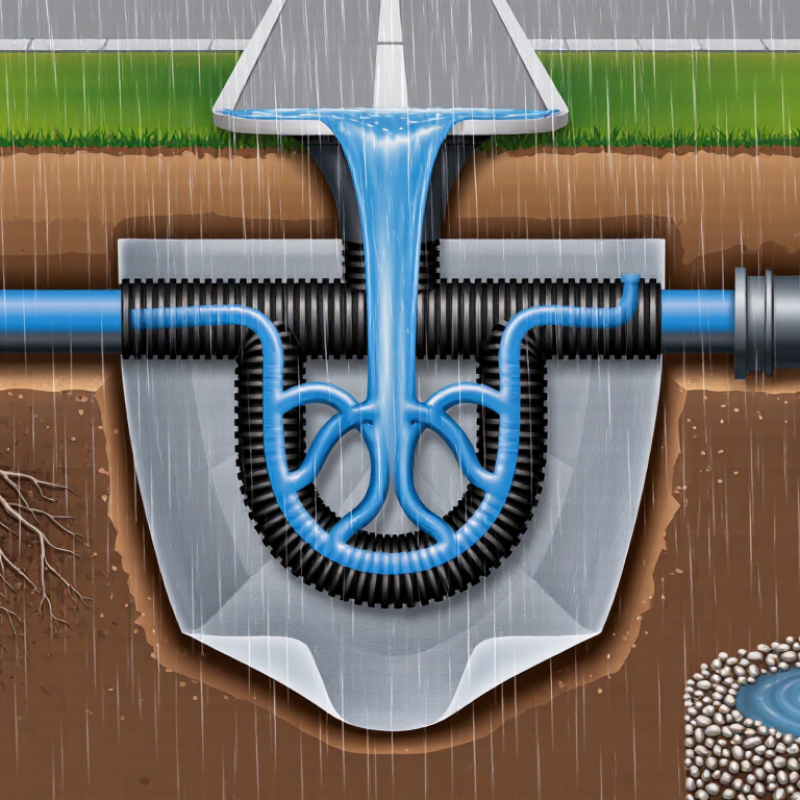
Table of Contents [Hide]
What Is a Plastic Blind Drain?
What Is a Plastic Blind Drain?
A plastic blind drain is a buried drainage unit that collects and redirects water through a narrow, permeable core. It usually combines a molded plastic drainage core with a geotextile filter. The filter lets water enter while limiting soil particles. Picture a slim, flexible channel beside a foundation or beneath a landscaped area. Water moves through its core toward an outlet, sump, or lower drainage point.
Unlike a gravel trench, this drain needs less excavation and can fit tight spaces. Its performance depends on the core shape, soil, installation, and compressive load. A detail is easy to miss: a filter fabric can clog if it does not suit the surrounding soil. The Federal Highway Administration’s Geosynthetic Design and Construction Guidelines (NHI-07-092) treats geocomposite drainage capacity as a design property requiring evaluation. ASTM D4716 measures in-plane water flow under specified hydraulic gradients and normal stresses. So, a capacity figure is meaningful only with its test conditions.
Designers should check test sheets for flow rate, applied pressure, and long-term reduction factors, rather than compare one headline number. The drain also needs a dependable discharge point; otherwise, collected water has nowhere to go. Installation matters. A crushed core, folded fabric, or poorly sealed outlet can undermine the system, even when the product data looks strong.
| Feature | Typical Details | Purpose and How It Works |
|---|---|---|
| Basic definition | An underground drainage trench containing a plastic pipe, permeable aggregate, or both. | It collects and redirects groundwater or seepage below the surface. It is called “blind” because it generally has no open surface channel or grate along its length. |
| Plastic drain pipe | Commonly perforated PVC or polyethylene pipe; around 100 mm (4 in) is often used for small-scale drainage, though sizing depends on site conditions. | Water enters through the perforations and flows inside the pipe toward a suitable outlet. Some systems use a solid pipe for the outlet section. |
| Drainage aggregate | Clean, washed, open-graded gravel or crushed stone is commonly placed around the pipe; particle size is selected for the design and soil conditions. | The voids between stones provide paths for water to move toward the pipe while supporting the trench around it. |
| Filter fabric | A permeable geotextile may line the trench or wrap the aggregate, depending on the soil and drainage design. | It allows water through while helping limit the movement of surrounding soil into the drainage stone and pipe. |
| Trench and depth | Trench width and depth vary with the water problem, soil, pipe size, and required cover. | The trench is positioned where water needs to be intercepted, such as beside a foundation or across a wet area. Its depth should be set for the site rather than assumed to be standard. |
| Pipe gradient | The pipe is usually laid to a continuous fall toward an outlet; the required gradient depends on the drainage design and site levels. | Gravity carries collected water along the pipe. A poorly graded or uneven pipe can leave standing water and reduce drainage performance. |
| Outlet | Water may discharge to an approved stormwater system, drainage structure, or other permitted outlet. | The outlet provides a destination for the collected water. Local rules and site conditions determine which discharge options are acceptable. |
| Typical applications | Groundwater control around foundations, soggy lawns, retaining walls, and other areas with subsurface seepage. | By lowering or intercepting water in the soil, a blind drain can help reduce waterlogging. It does not replace proper surface grading or waterproofing where those are needed. |
Note: Pipe size, trench dimensions, filter materials, and outlet requirements should be selected for the local soil, expected water flow, and applicable regulations.
Customers




Smart Robotics brand movie
Watch video