How to Choose Packaging Bags for Global Shipping?
Global shipping turns a simple bag into a risk-control decision. Packaging Bags must survive handling, stacking, moisture, abrasion, and long transit times. Rain at a port can weaken paper-based materials within hours. Sharp carton edges can puncture thin film. Weak seals may open before customs inspection or final delivery. The scale is significant. Pitney Bowes’ Parcel Shipping Index reported 161.1 billion parcels worldwide in 2022. Every parcel creates another opportunity for leakage, crushing, contamination, or customer complaints. The World Bank’s 2023 Logistics Performance Index assessed 139 economies and emphasized tracking, timeliness, and logistics reliability. Packaging supports all three, even when it receives little attention.
Choosing suitable Packaging Bags requires more than comparing prices per unit. It requires matching material structure, closure design, dimensions, and shipment conditions. ISO 18601 and related ISO 18602–18606 standards provide a useful framework for packaging optimization and environmental considerations. UNCTAD’s Review of Maritime Transport reports that maritime shipping carries over 80% of global merchandise trade by volume. That distance exposes packaging to vibration, humidity, temperature changes, and repeated transfers. Ask suppliers for puncture, tensile, seal-strength, and moisture-resistance evidence. Check whether labels remain readable after condensation and friction. A practical trial should include loaded bags, pallet compression, simulated drops, and real route conditions. No checklist is flawless. A bag that performs well in a warehouse may fail beside a wet container door. This guide examines those trade-offs, while recognizing that lower material use can sometimes reduce protection, not improve it.
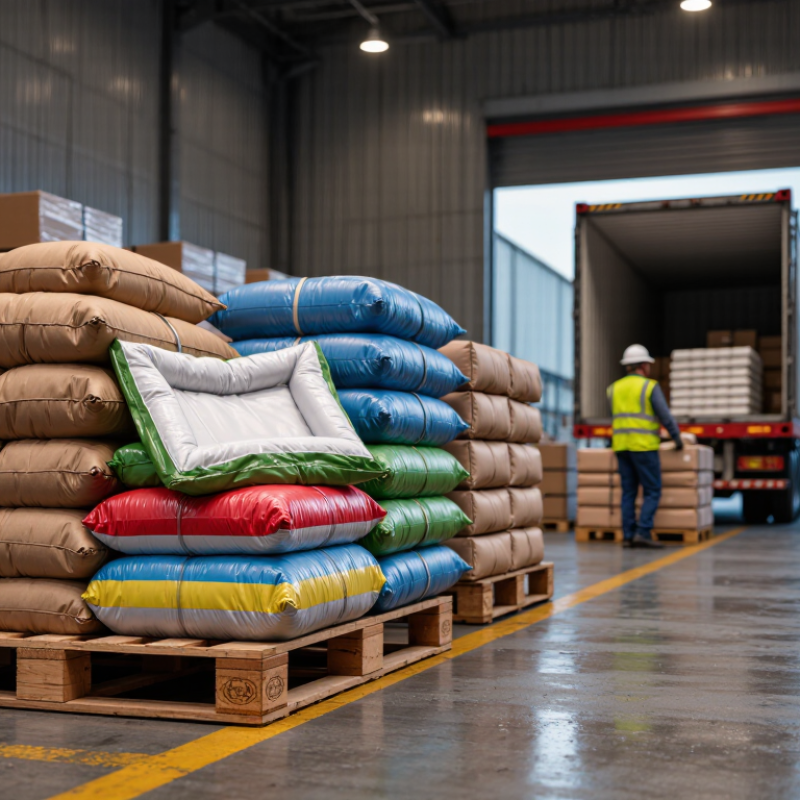
Classify Cargo by UNCTAD’s 80% Sea-Freight Reality and Route Risk
How to Choose Packaging Bags for Global Shipping?
Classify Cargo by UNCTAD’s 80% Sea-Freight Reality and Route Risk
More than 80% of global trade by volume moves by sea, according to UNCTAD’s Review of Maritime Transport 2024. A packaging bag may face weeks of vibration, stacking, salt air, and temperature changes. Classify the cargo before selecting the bag. Check moisture sensitivity, particle size, density, sharp edges, and loading weight. Fine powders need secure closures and dust control. Abrasive materials need stronger woven structures and protective liners. Moisture-sensitive cargo usually needs a sealed inner barrier.
Route risk changes the packaging decision. UNCTAD’s 2024 report, Navigating Troubled Waters, recorded major traffic declines through the Suez and Panama canals during disruption periods. Ships then used longer routes, increasing transit time and handling exposure. A bag designed for a ten-day voyage may fail after six weeks. Add stronger stitching, reinforced lifting points, and abrasion-resistant outer layers when transshipment is likely. Use desiccant only after checking cargo compatibility. More is not always safer.
From practical packaging trials, the weakest point is often the closure, not the fabric. I have seen a durable bag lose product through a poorly sealed mouth. It still happens. Test filled bags under stacked pressure, dropping, and humidity cycles. Keep records for weight, lot size, route, and warehouse conditions. This evidence supports a more reliable choice than appearance alone. Even experienced teams can misjudge risk when schedules change. Packaging specifications should be reviewed again before every major route change.
Select Film Strength Using ASTM D882 Tensile and ASTM D1709 Impact Tests
How to Choose Packaging Bags for Global Shipping?
Select Film Strength Using ASTM D882 Tensile and ASTM D1709 Impact Tests
Global shipping exposes packaging film to pulling, drops, compression, and cold transit. ASTM D882 helps measure tensile strength, elongation, and modulus in thin plastic films. Test samples should be cut in both machine and transverse directions. Film often behaves differently across those directions. Record thickness, temperature, and conditioning time beside every result.
ASTM D1709 evaluates impact resistance by dropping a dart onto a film specimen. Method A uses a smaller dart, while Method B uses a larger dart and a different energy range. The result estimates the energy needed to cause failure, not every puncture risk inside a shipping container. A high tensile value can still mislead. A stiff film may resist stretching but crack when a sharp corner hits it. D1709 adds that missing view. Neither test measures seal integrity.
In packing trials, compare laboratory data with filled bags, sealed edges, and rough handling. Watch the corners. A bag carrying dense hardware needs different protection from one holding soft garments. Check performance after cold storage, because some films lose flexibility below room temperature. One weakness in my early evaluations was trusting average values too quickly. Retesting failed samples, especially along seals, often reveals the practical cause. Choose film by balancing D882 strength, D1709 impact resistance, thickness, and real distribution conditions.
How to Choose Packaging Bags for Global Shipping? - Select Film Strength Using ASTM D882 Tensile and ASTM D1709 Impact Tests
| Packaging Film Structure | Typical Thickness | ASTM D882 Tensile Strength
MD / TD | ASTM D882 Elongation
MD / TD | ASTM D1709 Dart Impact | Recommended Shipping Exposure | Typical Application | Selection Assessment |
| Low-density polyethylene (LDPE) | 40–60 µm | 18–25 / 16–22
MPa | 350–600 / 450–700
% | 250–500
g, Method A | Low mechanical stress, lightweight contents, limited handling | Inner liners, apparel bags, soft and non-abrasive products | Suitable for low-risk parcels |
| Linear low-density polyethylene (LLDPE) | 60–80 µm | 25–35 / 22–30
MPa | 500–800 / 600–850
% | 600–1,000
g, Method A | Normal parcel handling, stacking, vibration and moderate abrasion | General export mailers, flexible pouches and poly shipping bags | Balanced option for standard global shipping |
| Coextruded PE film | 80–120 µm | 30–40 / 28–36
MPa | 500–750 / 550–800
% | 900–1,500
g, Method A | Long transit routes, mixed logistics networks and repeated handling | Heavy-duty courier bags, industrial components and export overpacks | Recommended for higher puncture and impact risk |
| Nylon/PE laminate | 70–100 µm | 65–100 / 55–90
MPa | 80–180 / 100–220
% | 600–1,200
g, Method A | Sharp-edged contents, high tensile loading and demanding distribution | Vacuum packs, dense parts, moisture-sensitive and puncture-prone goods | Strong tensile performance with good barrier capability |
| Biaxially oriented PP/PE laminate | 70–100 µm | 80–120 / 70–110
MPa | 80–160 / 100–180
% | 150–400
g, Method A | High tensile loads where puncture and flex-crack risk is controlled | Printed retail-ready pouches and rigid, non-abrasive products | High tensile strength; verify impact performance before use |
| Reinforced PE film with scrim or mesh | 100–180 µm | 45–80 / 40–75
MPa | 30–120 / 40–140
% | 800–1,500
g, Method A | Very heavy loads, outdoor exposure and rough manual handling | Bulk liners, oversized shipments and heavy industrial packaging | Use when load retention and tear resistance are critical |
Test and selection note: MD means machine direction and TD means transverse direction. ASTM D882 is used to measure tensile properties of thin plastic sheeting and films, while ASTM D1709 measures impact resistance using a falling dart. The ranges above are typical engineering reference values for commonly used film structures; actual results depend on resin grade, additives, orientation, layer design, sealing conditions and test laboratory procedures. For international shipping, confirm the selected film with finished-bag testing, including seam strength, seal integrity, drop testing and puncture testing.
Size Bags for Product Fit and Carriers’ Dimensional-Weight Rules
How to Choose Packaging Bags for Global Shipping?
Size Bags for Product Fit and Carriers’ Dimensional-Weight Rules
A shipping bag should hold the product closely, without crushing it or leaving large empty spaces. Measure the item after folding, sealing, and adding protective material. Do not measure the loose product alone. A soft sweater may fit a compact mailer, while a rigid accessory needs extra width and depth. The final packed size matters.
Carriers often compare actual weight with dimensional weight. Dimensional weight is calculated from the package’s length, width, and height, divided by a carrier-specific factor. Rules can vary by destination and service. Check the current calculation before selecting bag sizes. A bag that weighs little may still cost more if its filled dimensions are excessive. Record both measurements for each common product.
During packing tests, place a ruler beside the sealed bag and photograph the result. This creates useful evidence for later purchasing decisions. I once chose a larger bag to speed up packing. It seemed efficient. However, extra air increased shipping charges and required more filler. That decision needed review. Test several sizes with real products, not empty samples. A snug fit usually protects margins, but overly tight seals can damage corners or closures. Leave practical space for handling. Small details matter.
Validate Closures with ISTA 3A Parcel Tests up to 150 lb (70 kg)
How to Choose Packaging Bags for Global Shipping?
Global parcel networks are unforgiving. The 2023 Parcel Shipping Index recorded more than 160 billion parcels worldwide in 2022. That volume means packaging bags face repeated handling, vibration, stacking, and sudden drops. A bag that survives warehouse storage may still fail during delivery. Choose film strength, seam construction, and closure design together. Do not judge a closure by appearance alone.
ISTA 3A parcel testing evaluates packaged products moving through common parcel systems, including shipments up to 150 lb (70 kg). The test sequence can expose weak closures through conditioning, compression, vibration, and impact. Fill the bag to its actual shipping weight. Use the real closure method. Then inspect for channel leaks, torn seams, zipper separation, and product movement. This detail matters. A closure can look secure and still open after one corner drop.
In practical trials, seal a small group of bags at different temperatures and pressures. Record opening force before and after testing. Compare results across film thicknesses, because thicker material does not automatically create a stronger closure. The World Bank’s 2023 Logistics Performance Index also shows uneven logistics performance between countries, so transit conditions will vary. That makes overconfidence risky. One test cycle is useful, but not final. Repeat testing after design changes, and keep failed samples for review. The uncomfortable truth is simple: laboratory success can hide field weaknesses, especially when operators close bags inconsistently.
How to Choose Packaging Bags for Global Shipping?
Validate Closures with ISTA 3A Parcel Tests up to 150 lb (70 kg)
Closure retention Check that zippers, adhesive seals, welds, and other closures remain secured after handling impacts.
Seam integrity Inspect seams and gussets for tearing, splitting, or permanent deformation.
Leak protection For liquid or fine-powder contents, verify that the tested bag prevents leakage and contamination.
Post-test usability Confirm that the package remains closed, protective, and suitable for delivery after testing.
The chart shows reference parcel payload points within the ISTA 3A scope. The kilogram values are conversions from pounds using 1 lb = 0.453592 kg. Actual test conditions depend on package size, product fragility, distribution environment, and the applicable ISTA 3A test sequence.