Demand for large, flexible openings is reshaping commercial, industrial, and premium residential construction. Heavy-Duty Sliding & Folding Doors support wide spans, smoother circulation, and better visual access. They are often specified for warehouses, hotels, showrooms, airports, and modern homes.
Grand View Research reported that the global doors market was valued at more than USD 200 billion in 2023. Its forecast also indicates steady growth through 2030, supported by renovation, urbanization, and energy-efficiency requirements. Mordor Intelligence similarly identifies Asia-Pacific as a major growth region for architectural and industrial door systems. China therefore remains an important manufacturing base, combining material supply, engineering capacity, and export experience.
The ten manufacturers in this guide are assessed through practical indicators. These include load capacity, track design, corrosion resistance, sealing performance, customization, testing, and after-sales support. Factory experience matters. So does documented quality control. A polished catalog alone proves little. ASTM, EN, ISO, and project-specific compliance should be checked against the destination market.
Market figures are not perfectly consistent. Different reports use different product definitions and forecast periods. That limitation deserves attention. Some suppliers also describe ordinary systems as “heavy duty” without publishing meaningful test data. Buyers should request drawings, hardware specifications, cycle-test results, surface-treatment details, and installation references before making a decision.
This overview of China’s top ten Heavy-Duty Sliding & Folding Doors manufacturers aims to create a clearer comparison. It focuses on verifiable capabilities rather than promotional claims. Yet supplier performance can vary by project. Independent inspection remains wise.
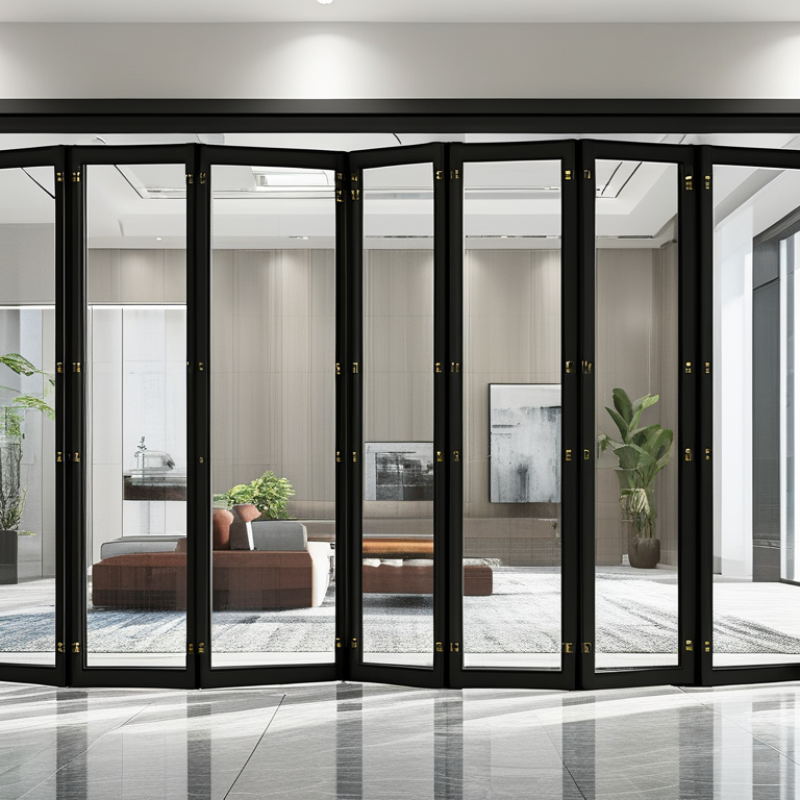
China’s heavy-duty sliding folding door market is expanding with logistics parks, factories, hangars, and large commercial facilities. These doors combine lateral sliding with folding leaves, saving clearance where swing doors are impractical. Demand is strongest in projects requiring wide openings, frequent vehicle movement, and controlled indoor conditions. A typical installation may span six to twelve meters, although dimensions depend on wind exposure and structural support. Steel, aluminum, and insulated panel options serve different thermal and loading needs. The market is diverse.
Manufacturers compete through load capacity, hardware durability, customization, and installation service. Experienced suppliers usually assess the opening, floor level, drainage, wind pressure, and daily operating cycles before quoting. Rollers should move smoothly under load, while hinges need protection from dust and moisture. Seals, tracks, locks, and emergency access also affect long-term performance. In coastal areas, corrosion-resistant finishes can reduce maintenance. In dusty workshops, track cleaning matters more than attractive surface treatment. Small details matter.
Buyers increasingly request test data, material certificates, production photographs, and clear warranty terms. Reliable factories can explain tolerance limits instead of promising unlimited performance. They should also provide drawings, installation guidance, spare parts, and responsive after-sales support. However, pricing comparisons remain difficult because specifications are often incomplete. A low quote may exclude reinforcement, transport, or commissioning. This is where careful review helps. The sector still needs better standardized data and more transparent lifecycle cost reporting.
China’s construction industry output value provides a reliable macro-level indicator of potential demand for heavy-duty sliding folding doors in commercial, industrial, logistics, and public-building projects. The figures below are reported in trillion yuan and are not company or brand sales data.
Source: China National Bureau of Statistics, annual construction industry output value, 2020–2024. Market context indicator only; it does not represent the revenue of the heavy-duty sliding folding door segment.
Ranking heavy duty sliding folding door manufacturers requires more than comparing catalog photos. The first measure is engineering performance. Reviewers should examine load calculations, panel alignment, hinge strength, track design, and operating resistance. A serious factory can provide drawings, material specifications, and test records. Real production experience matters.
Manufacturing quality deserves practical inspection. Check weld consistency, coating thickness, seal fit, and hardware movement on finished samples. Open and close the door repeatedly. Listen for grinding, watch for uneven gaps, and record deformation. Cycle testing helps reveal weaknesses that a showroom visit may hide. Quality control records should connect raw materials with final inspection.
Reliability also depends on delivery discipline and technical support. Compare stated lead times with previous project evidence, not promises alone. Evaluate installation guidance, spare-part availability, packaging strength, and response procedures after delivery. Independent certifications can support trust, but certificates should match the actual product and factory scope. A low quotation may exclude important details.
A transparent ranking should use weighted scores for engineering, durability, production control, customization, service, and value. The weights must reflect real applications, such as warehouses, workshops, or coastal buildings. No scoring model is perfect. Site conditions can expose assumptions. We would review the ranking regularly, because supplier performance and material costs change. A manufacturer with fewer marketing claims may still deserve close attention when its records are complete, consistent, and verifiable.
China’s top 10 heavy-duty door manufacturers are best assessed through engineering evidence, not online visibility. Grand View Research reports that the global doors market continues to expand with commercial construction and renovation demand. In China, this trend supports manufacturers offering reinforced aluminum systems, insulated panels, and corrosion-resistant hardware. The strongest profiles usually include factory testing, documented load ratings, and project experience in warehouses, airports, and industrial facilities.
The first group excels in oversized sliding-folding systems. Their doors often use multi-point rollers, stainless-steel tracks, and adjustable hinges. The second group focuses on thermal performance. This matters because China’s building-energy standards increasingly encourage better envelope efficiency. A 2024 report from the China Academy of Building Research highlights the growing importance of airtightness and insulation in modern building design. Some manufacturers also provide wind-load calculations and finite-element analysis. Useful details.
Another group serves coastal and high-humidity projects, using powder-coated frames and sealed bearings. Others specialize in rapid customization, producing large openings with short lead times. Construction market reports from Mordor Intelligence identify industrial and commercial development as major demand drivers for architectural doors. However, published performance data remains uneven. Some suppliers show impressive factory photographs but provide limited cycle-test records. That weakness deserves attention. Buyers should request material certificates, installation references, warranty terms, and independently verified test results before ranking any manufacturer. A strong door is not merely large; it must remain stable after thousands of daily movements.
China’s top ten heavy-duty sliding folding door manufacturers compete through stronger hardware, tighter tolerances, and flexible production.
Their systems commonly use galvanized steel, aluminum alloys, stainless steel tracks, and laminated safety glass. Material choice affects weight, corrosion resistance, insulation, and service life.
A serious product review should examine panel load ratings, hinge geometry, roller design, and locking points.
Smooth operation matters. A door may look impressive yet fail under frequent loading.
The UNEP Global Status Report for Buildings and Construction 2023 states that buildings consumed about 30% of global final energy in 2022. Therefore, thermally broken frames, insulated panels, and effective seals deserve attention, especially in warehouses and logistics facilities.
Manufacturers offering low-emissivity glazing or insulated cores can reduce heat transfer, although advertised performance still requires test evidence.
Manufacturing capability separates reliable suppliers from catalog sellers.
Useful indicators include CNC cutting, robotic welding, powder-coating control, glass processing, and documented quality inspections.
China remains a major steel producer, with World Steel Association data reporting more than one billion tonnes of crude steel output in 2024. This supports broad material access, but it does not automatically prove better door quality.
Factory audits should verify batch traceability, coating thickness, dimensional checks, and repeated opening-cycle tests.
Certifications help. They are not the whole answer.
Some suppliers publish impressive specifications but provide limited field data, which deserves careful questioning. Door samples should be tested with realistic loads, uneven floors, wind pressure, and daily operating conditions.
Selecting a Chinese heavy duty sliding folding door manufacturer requires more than comparing catalog prices. Start with project conditions: opening width, panel weight, wind exposure, cycle frequency, and site drainage. Ask for load calculations, section drawings, material certificates, and tested hardware data. I prefer suppliers that explain tolerances clearly, not those promising “unlimited” customization.
The UNEP Global Status Report for Buildings and Construction 2023 found that buildings used about 30% of global final energy in 2022. Door insulation and airtightness therefore deserve serious attention. Request U-values, air-leakage results, thermal-break details, and weather-seal specifications. EN 13241 and ISO 9001 references can support evaluation, but certificates alone do not prove product quality. Check whether the certificate covers the actual door model.
Tips: Send one complete technical brief. Include drawings, finish requirements, delivery terms, and installation conditions. Ask for a sample corner, not only photographs. Test the folding movement by hand. It should feel controlled, without scraping, sudden drops, or uneven gaps.
Factory audits should examine welding consistency, coating thickness, assembly space, and spare-parts control. Confirm who manages engineering changes and after-sales claims. A video inspection is useful, but it cannot replace physical verification. I once underestimated floor-level variation on a large opening; the door still worked, but installation took longer than planned. Leave adjustment space in the design. Use staged payments linked to approved drawings, inspection, and packing records. 马会
| No. | Selection Dimension | Recommended Project Benchmark | Documents and Verification Points | Why It Matters |
|---|---|---|---|---|
| 01 | Application Experience | Project Fit Select a manufacturer with proven experience in the same application, such as warehouses, factories, logistics facilities, hangars, cold rooms, or commercial buildings. | Request anonymized project references, installation photographs, operating conditions, door dimensions, and maintenance records. Confirm that the references involve comparable door loads and usage frequency. | Similar project experience reduces design errors, installation problems, and unsuitable hardware selection. |
| 02 | Door Size and Load Capability | Engineering Capacity The manufacturer should provide structural calculations for the proposed width, height, panel weight, folding configuration, wind exposure, and support conditions. | Check approved drawings, load calculations, panel-weight data, hinge specifications, trolley details, and the maximum tested or engineered opening size. | Heavy-duty doors require coordinated structural and hardware design; nominal size claims alone are not sufficient. |
| 03 | Applicable Standards | Compliance Confirm which standards apply to the destination market and door type. Relevant references may include EN 13241 for industrial, commercial, and garage doors and gates, together with related mechanical, thermal, air, water, or wind-performance standards where applicable. | Ask for current test reports, declarations, technical files, and the exact product configuration covered by each report. Avoid accepting certificates that apply only to a different model. | Correct standards documentation supports approval, tender compliance, insurance requirements, and safer project delivery. |
| 04 | Material and Corrosion Protection | Service Life Evaluate steel or aluminum grade, panel construction, coating system, fasteners, hinges, tracks, rollers, and suitability for humidity, salt air, chemicals, or low temperatures. | Request material certificates, coating specifications, surface-treatment details, corrosion-test information where relevant, and a written list of standard and optional materials. | Material selection strongly affects durability, maintenance intervals, appearance, and total ownership cost. |
| 05 | Operating Cycle and Hardware Durability | Reliability Match the rated operating frequency and cycle life to the actual duty class of the facility rather than choosing solely by purchase price. | Request cycle-test results, hardware load ratings, replacement-part specifications, lubrication requirements, and the recommended preventive-maintenance schedule. | Properly rated hardware helps prevent premature roller, hinge, track, and alignment failures. |
| 06 | Manual or Motorized Operation | Access Strategy Choose manual operation for low-frequency use or simple access; consider motorized operation when opening speed, traffic flow, remote control, or integration with site systems is important. | Verify motor torque, control-panel functions, emergency release, safety edges, photoelectric sensors, limit switches, power requirements, and compatibility with access-control systems. | A correctly matched drive system improves safety and avoids operating problems caused by excessive panel weight or unsuitable controls. |
| 07 | Safety and Emergency Functions | Risk Control The design should address pinch points, trapped-person risks, uncontrolled movement, manual release, emergency access, and safe stopping during abnormal operation. | Review the risk assessment, safety-device layout, installation instructions, warning labels, emergency procedures, and commissioning checklist. | Safety provisions protect users, support regulatory approval, and reduce operational liability. |
| 08 | Customization and Integration | Design Flexibility Confirm the manufacturer can adapt panel configuration, glazing or vision sections, insulation, thresholds, tracks, colors, locks, seals, and access-control interfaces to the project requirements. | Request shop drawings, interface details, color and finish samples, allowable tolerances, connection dimensions, and a clearly defined list of included and excluded items. | Detailed customization control prevents site conflicts between the door, building structure, electrical systems, and security equipment. |
| 09 | Quality Control and Traceability | Manufacturing Control A dependable supplier should operate documented incoming-material, in-process, dimensional, welding, coating, assembly, and final-inspection procedures. | Ask for quality manuals, inspection and test plans, sample inspection reports, serial-number or batch traceability, factory photographs, and evidence of a functioning quality-management system. | Traceable production improves consistency and makes corrective action easier if a problem occurs after delivery. |
| 10 | Export Service and After-Sales Support | Lifecycle Support Compare delivery terms, export packaging, installation support, spare-parts availability, warranty scope, response time, and technical communication in English. | Review the commercial quotation, Incoterms, packing list, warranty exclusions, spare-parts list, commissioning procedure, remote-support process, and escalation contacts. | Strong post-sale support lowers downtime and makes long-term operation more predictable for international projects. |
Watch video