China Top 10 Carbon Fiber Production Line Factory Suppliers?
China’s carbon fiber industry is moving from expansion toward higher consistency, stronger process control, and specialized applications. This article introduces ten leading Carbon fiber production line factory suppliers in China. The selection considers production experience, precursor compatibility, carbonization technology, automation, quality systems, installation support, and after-sales service. A polished website is not enough. Factory evidence matters more.
Toray Industries’ former president, Akihiro Nikkaku, described carbon fiber as “a key material for the future of mobility and energy.” That perspective explains the industry’s direction. Modern production lines must manage oxidation ovens, carbonization furnaces, surface treatment, sizing, winding, and exhaust control. Each stage affects tensile strength, modulus, surface quality, and production yield. A small temperature variation can change the final fiber performance. Serious suppliers therefore provide process data, trial production, operator training, and maintenance plans.
The ranking remains practical, not absolute. Supplier capabilities change quickly. Some companies excel at PAN-based lines, while others focus on pilot systems or large industrial capacity. Public information can also be incomplete. Buyers should verify factory visits, reference projects, energy consumption, warranty terms, and spare-part availability. They should request samples from comparable production conditions. That step is often overlooked.
Price alone misleads. A cheaper line may create higher waste, unstable quality, or difficult commissioning. The strongest Carbon fiber production line factory partners understand the entire process, not only individual equipment. They also explain limitations clearly. That honesty deserves attention. This guide offers a structured starting point, while final supplier decisions should follow technical audits, testing, and commercial due diligence.
What Is a Carbon Fiber Production Line?
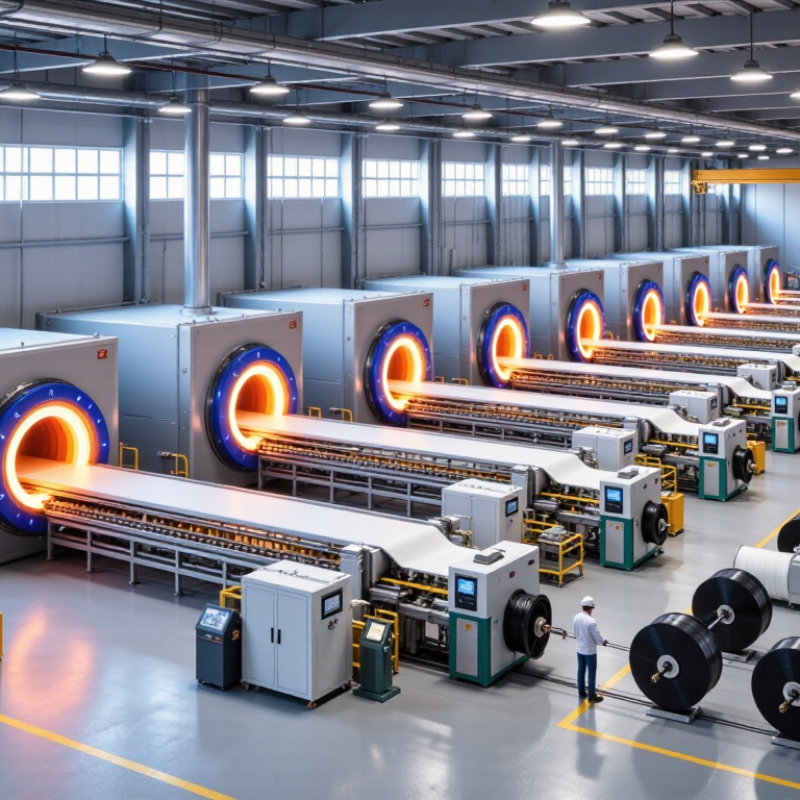
A carbon fiber production line is an integrated system that converts precursor fiber into strong, lightweight carbon filaments. Most commercial lines use polyacrylonitrile, or PAN, as the starting material. The process includes precursor preparation, oxidation, carbonization, surface treatment, sizing, drying, and winding.
The fiber first passes through heated oxidation ovens, often near 200–300°C. Stabilization prevents the material from melting during later treatment. Carbonization then occurs in oxygen-controlled furnaces, commonly between 1,000°C and 1,500°C. Higher-performance grades may require additional graphitization above 2,000°C. The line must control tension carefully. Small alignment errors can reduce strength and increase waste.
A production line also needs exhaust treatment, cooling systems, online inspection, and precise spool handling. According to U.S. Department of Energy and Oak Ridge National Laboratory assessments, conventional carbon fiber manufacturing can consume roughly 286 MJ of energy per kilogram. That figure makes furnace efficiency more than a design detail. It affects operating cost and emissions.
Supplier comparisons should examine actual line speed, annual output, furnace temperature stability, energy recovery, and maintenance access. A quoted capacity can be misleading. It may describe theoretical output, not stable production with acceptable fiber quality. I would also question commissioning support and process training. These details are easy to overlook, yet they often decide whether a new line performs reliably after installation.
Key Technologies Used in Carbon Fiber Manufacturing
Carbon fiber production lines depend on controlled chemistry, heat, tension, and timing. The process usually begins with polyacrylonitrile precursor fibers. They are stretched, oxidized, and stabilized in air at approximately 200–300°C. This stage forms the ladder structure needed for later carbonization.
Carbonization follows in oxygen-free furnaces. Temperatures commonly reach 1,000–1,500°C, while higher-performance grades may require graphitization above 2,000°C. Line suppliers must control furnace atmosphere, fiber speed, and temperature uniformity. A small hot spot can weaken thousands of filaments. According to Lucintel’s 2024 Carbon Fiber Market Report, global demand is expected to grow steadily through 2030, supported by aerospace, wind energy, and hydrogen storage. That growth increases pressure on production efficiency.
Surface treatment improves bonding with resin, while sizing protects filaments during weaving and winding. Modern lines also use online tension sensors, infrared monitoring, and automated defect detection. These systems reduce breaks, but they do not remove process risk. CompositesWorld’s 2024 market review identifies capacity expansion and energy consumption as continuing industry concerns. Recovery of heat from carbonization furnaces can lower operating costs. However, poorly designed recovery systems may disturb temperature stability. The better question is not simply whether a factory has advanced equipment. It is whether each stage works together, from precursor quality to final spool inspection. No line is perfect. Pilot trials still matter.
Criteria for Evaluating Carbon Fiber Line Suppliers
Criteria for Evaluating Carbon Fiber Line Suppliers
When evaluating carbon fiber production line suppliers, examine their practical experience, not only their brochures. Ask how many complete lines they have commissioned and which tow sizes they have processed. Experienced teams should explain precursor handling, oxidation control, carbonization temperatures, surface treatment, and winding tension clearly. Numbers need context. Request production records, maintenance logs, and customer references from comparable projects.
Visit an operating line when possible. See the line running. Observe furnace stability, fiber alignment, exhaust handling, and operator access. A reliable supplier should provide process data, equipment drawings, spare-parts lists, and training plans. Check whether sensors can detect tension changes before fiber breaks occur. Small control details often affect yield more than impressive rated capacity.
Quality assurance also deserves close attention. Review material traceability, calibration routines, inspection methods, and factory acceptance procedures. Ask how the supplier manages temperature uniformity across long furnaces. Their answer should include measurable tolerances, not vague promises. Safety documentation and compliance with applicable local standards must be current and verifiable. Proof beats promises.
Cost remains important, but the lowest quotation can hide weak commissioning support or expensive downtime. Compare energy consumption, installation requirements, software access, and response times for technical service. I have learned that supplier evaluation is rarely perfect; production conditions change after installation. Leave room for pilot testing, honest process adjustments, and independent performance checks. A polished proposal is not proof.
China’s Top 10 Carbon Fiber Production Line Suppliers
China’s Top 10 Carbon Fiber Production Line Suppliers are often evaluated by engineering depth, delivery records, and process consistency. A reliable supplier should provide more than individual machines. It should coordinate precursor handling, stabilization ovens, carbonization furnaces, surface treatment, sizing, winding, and control systems. Factory visits can reveal practical details that brochures miss, such as cable routing, furnace insulation, and maintenance access.
Experienced buyers should request verified data for tensile strength, modulus, line speed, energy use, and production yield. Trial runs with the customer’s selected precursor are especially important. They show whether temperature zones remain stable across continuous operation. Good suppliers also offer installation guidance, operator training, spare parts, and documented quality procedures. Batch records and calibration reports support traceability.
No supplier is perfect. Some proposals look impressive but provide limited evidence from long-term production. Others offer strong equipment yet weak after-sales support. This is where technical audits become valuable. Buyers should compare acceptance standards, response times, warranty terms, and upgrade options before signing. A supplier may also need to adjust furnace length or tension control for different tow sizes. Small details matter. Even minor tension changes can affect filament alignment and final mechanical performance.
How to Select the Right Chinese Factory Supplier
Selecting a Chinese carbon fiber production line supplier requires more than comparing prices. Global Wind Energy Council reported 117 GW of new wind capacity in 2023. That growth increases demand for stable, large-format composite components. A supplier should therefore show recent production records, not only attractive brochures. Ask for line speed, fiber yield, energy use, tow size, furnace temperature control, and proven annual output. Request test samples from the same line proposed for your project.
Audit the factory before signing. Check precursor storage, oxidation ovens, carbonization furnaces, surface treatment, and laboratory equipment. Review batch records and calibration certificates. ISO 9001 certification helps, but it does not replace process evidence. MarketsandMarkets’ carbon fiber industry outlook identifies aerospace, wind energy, and automotive applications as major demand sectors, with continued high growth expected through 2028. Your supplier should explain how its line handles different grades and changing specifications.
Insist on a documented acceptance test. It should measure tensile strength, modulus, sizing consistency, breakage rate, and power consumption. Confirm spare-part availability, technician response time, training, and software access. Ask who controls critical components. A low quotation may exclude installation, commissioning, or furnace maintenance. That mistake becomes expensive quickly. Factory visits are useful, but one visit can mislead. A quiet demonstration line may not represent continuous production. Independent testing and a small paid trial order provide stronger evidence. No supplier is perfect. The best choice is the one that exposes weaknesses clearly and corrects them with measurable deadlines.