China Top 10 Power Transmission Parts Manufacturers?

Choosing among China’s top 10 Power Transmission Parts manufacturers takes more than comparing catalog prices. Buyers need to examine materials, machining accuracy, heat treatment, inspection records, and delivery consistency. A gear that looks flawless on a sample may behave differently after months of load, heat, and vibration. Small details matter.

Mechanical design author Robert L. Norton’s work emphasizes how component geometry and operating conditions shape machine performance. Put simply, a transmission part must suit the system around it. This is a paraphrase of that engineering principle, not a direct quotation. It offers a useful lens for assessing manufacturers: ask how they control tolerances, verify materials, and respond when a part fails inspection.

This guide reviews ten Chinese manufacturers of Power Transmission Parts, including the product ranges and production capabilities they report. It also considers practical factors such as customization, quality documentation, export experience, and technical support. Company claims should be checked against current certificates, samples, and project references. That work takes time. It can also reveal gaps that a polished website will not show.

No supplier is right for every application. A compact coupling for a packaging line has different demands from a heavy-duty gear used in mining equipment. The comparisons ahead can help narrow the field, but they are not a substitute for engineering review. Even a strong shortlist needs a second look.
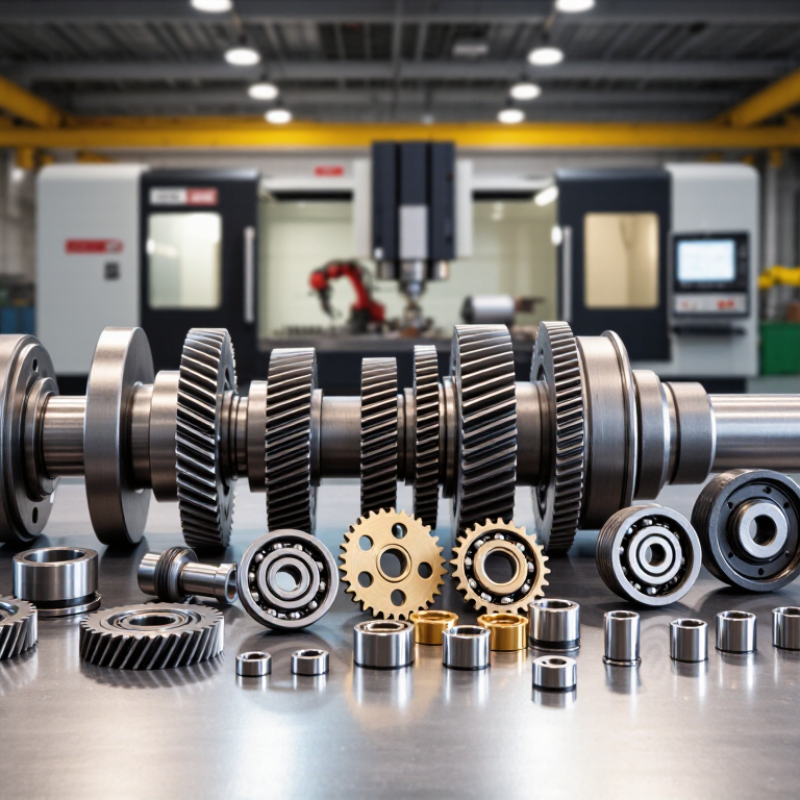
China Top 10 Power Transmission Parts Manufacturers?

What Power Transmission Parts Include and Where They Are Used

Power transmission parts move torque, speed, and motion between machines. Common components include gears, gearboxes, bearings, shafts, couplings, belts, chains, sprockets, clutches, and brakes. A conveyor may use a helical gearbox, flexible coupling, and sealed bearings. A packaging line often combines timing belts with precision shafts and tensioners.

Their applications differ sharply. Gears reduce speed and increase torque in cranes, mixers, and industrial robots. Bearings support rotating shafts while limiting friction and heat. Chains suit dusty conveyors and agricultural equipment, while belts offer quieter operation in fans and material-handling systems.

Couplings absorb misalignment between a motor and driven machine. Small alignment errors matter.

The market is substantial. Grand View Research estimated the global industrial gearbox market at about USD 28.8 billion in 2023, with a projected 4.6% compound annual growth rate through 2030. The International Energy Agency reported that motor-driven systems consume roughly 70% of industrial electricity. Efficient transmission parts therefore influence operating costs, not only mechanical performance.

For buyers reviewing China’s top ten power transmission parts manufacturers, testing should match the application. Check load ratings, lubrication needs, sealing quality, noise, and service life. A higher precision bearing can fail early if installation is careless. That practical detail is often overlooked. Datasheets help, but field conditions decide the result. Geological dust, temperature changes, and uneven maintenance can challenge even well-designed assemblies.

How China's Power Transmission Parts Industry Is Organized

China’s power transmission parts industry is not one uniform factory. It is a layered network of material suppliers, component specialists, equipment integrators, and export distributors. Steel producers supply shafts, gears, and housings. Precision workshops then add heat treatment, machining, sealing, or balancing services. Smaller factories often focus on one process, while larger manufacturers coordinate several stages.

Demand is closely linked to grid expansion, industrial automation, wind power, and factory upgrades. The China Electricity Council reported approximately 527.5 billion yuan in national power-grid investment during 2023. The International Energy Agency also recorded China as the largest contributor to global electricity-demand growth that year. These figures support strong demand for bearings, couplings, gearboxes, chains, belts, and related maintenance parts. However, demand alone does not prove consistent quality.

Tips: Buyers should audit the full production chain, not only the final assembly site. Check steel certificates, heat-treatment records, dimensional reports, and fatigue-test methods. A supplier with clear traceability is usually easier to evaluate.

China’s market is also organized by regional manufacturing clusters. Some areas concentrate on heavy transmission equipment. Others serve agricultural machinery, logistics systems, or renewable-energy projects. Export-oriented suppliers commonly work through agents, trading companies, and technical distributors. This structure improves flexibility, but it can blur accountability. Product descriptions may look precise while after-sales data remains incomplete. That weakness deserves attention. Comparing failure rates, replacement intervals, and inspection records gives a more practical view than catalog prices.

China Power Transmission Parts Industry: Typical Mechanical Efficiency by Product Category

China’s power transmission parts industry is organized around several core product groups, including gears, gearboxes, belts, chains, couplings, bearings, shafts, pulleys, sprockets, and linear transmission components. The chart shows representative mechanical-efficiency values commonly used in engineering applications. Actual performance varies with load, speed, lubrication, alignment, material, and maintenance.

Criteria for Identifying Leading Manufacturers in China

When identifying China’s leading power transmission parts manufacturers, product consistency should outweigh attractive catalogues. Inspect the factory’s machining, heat-treatment, and surface-finishing processes. Ask for recent inspection records, material certificates, and dimensional reports. A reliable supplier can explain tolerances clearly, not merely promise “high quality.”

Experience matters during factory evaluation. Review how the manufacturer handles custom gears, couplings, bearings, chains, and pulleys under real operating conditions. Request samples from current production, then measure tooth profiles, hardness, runout, and surface finish. Check whether each batch has a traceable lot number. Small details reveal discipline. Ask about tooling maintenance, calibration schedules, and staff training. These answers often matter more than a polished website.

Authority should be supported by verifiable evidence. Examine quality-system certifications, independent test results, export documentation, and customer references from similar industries. Do not accept certificates without checking their scope and validity. Lead times, packaging strength, spare-part support, and communication also deserve practical testing. Place a controlled trial order before signing a large contract. No evaluation is perfect. A supplier may pass an audit yet struggle with urgent changes or inconsistent raw materials. That weakness should be recorded, discussed, and monitored through measurable corrective actions. Reliability grows through evidence, not confident language.

China Top 10 Power Transmission Parts Manufacturers? - Criteria for Identifying Leading Manufacturers in China

Objective evaluation framework based on internationally recognized standards, manufacturing capability, quality systems, and export readiness

No. Evaluation Dimension Key Data to Verify Relevant Standard or Reference Suggested Weight Leading-Manufacturer Indicator
1 Quality Management System Valid certification scope, issuing body, audit status, corrective-action records, and traceability procedures ISO 9001:2015 15% A documented quality system covering design, purchasing, production, inspection, and after-sales service
2 Product Compliance Routine-test reports, type-test reports, material certificates, and product conformity documentation Applicable IEC, GB/T, ASTM, EN, or customer-specific specifications 14% Products are tested against the exact voltage, mechanical, thermal, and environmental requirements of the project
3 Testing and Laboratory Capability In-house equipment, calibration records, test capacity, laboratory accreditation, and third-party verification ISO/IEC 17025 for competent testing laboratories 12% Critical electrical, mechanical, dimensional, thermal, and corrosion tests can be completed with controlled records
4 Manufacturing Capacity Annual output, production lead time, equipment list, shift capacity, bottleneck processes, and expansion plans Project demand, delivery schedule, and approved production plan 12% Capacity is supported by documented production records rather than only quoted maximum output
5 Material and Component Control Approved supplier list, incoming inspection, heat or batch traceability, material certificates, and counterfeit-part controls ISO 9001 purchasing controls and applicable material standards 10% Conductors, metals, polymers, insulation materials, and hardware can be traced to controlled sources
6 Product Range and Engineering Support Transmission fittings, conductors, insulators, cable accessories, grounding components, drawings, and customization capability IEC 60826, IEC 61109, IEC 61284, IEC 60228, or relevant product standards 10% Engineering teams can provide load calculations, interface drawings, material selection, and installation guidance
7 Environmental and Occupational Controls Environmental policy, energy and waste controls, worker-safety procedures, incident statistics, and compliance records ISO 14001:2015 and ISO 45001:2018 8% Environmental and safety management systems are implemented, audited, and supported by measurable objectives
8 Export and Logistics Readiness Export documentation, packaging specifications, Incoterms capability, container planning, customs experience, and delivery history Contract terms, destination-country import rules, and project logistics requirements 7% The manufacturer can consistently manage international packing, shipping documents, inspection, and delivery milestones
9 Project References and Reliability Completed project references, failure rates, warranty claims, nonconformance records, and customer acceptance evidence Auditable customer references and documented quality-performance data 7% Performance evidence covers comparable voltage levels, climate conditions, quantities, and installation environments
10 Commercial Competitiveness and Service Total landed cost, quotation transparency, warranty terms, spare-parts availability, response time, and technical support Tender requirements, warranty conditions, service-level agreements, and total-cost-of-ownership analysis 5% Competitive pricing is balanced with verified quality, dependable delivery, clear warranty coverage, and responsive support
Total Evaluation Weight 100% Use documentary evidence, factory audits, sample inspections, and reference checks before final selection

Profiles of 10 Chinese Power Transmission Parts Manufacturers

Profiles of 10 Chinese Power Transmission Parts Manufacturers

China’s power transmission sector serves factories, ports, elevators, wind equipment, and agricultural machines. The IEA’s Electricity 2024 report projects global electricity demand to grow about 4% annually through 2026. That growth increases demand for dependable mechanical transmission components.

The first profile covers a coastal manufacturer producing forged shafts and precision hubs. Another specializes in helical and planetary gearboxes for conveyor systems. A central China supplier focuses on industrial chains, sprockets, and heat treatment. One eastern factory makes flexible couplings for pumps and compressors. A northern producer supplies large bearings for cranes and steel equipment. Another develops timing belts and pulleys for automated lines.

The remaining profiles include a southern maker of worm gears, a western producer of agricultural drive parts, and a precision workshop serving robotic equipment. A separate specialist manufactures brake drums and torque limiters for heavy machinery. The tenth profile represents a custom machining supplier handling low-volume shafts, flanges, and keyed assemblies. Factory visits matter here. Catalog claims can hide tolerance problems, weak traceability, or inconsistent lubrication control. Buyers should review ISO 9001 records, material certificates, fatigue testing, and dimensional inspection reports. These checks do not remove every risk. They expose it earlier. Reports from the International Organization for Standardization also stress process control, but certification alone cannot prove field reliability. Pilot orders and inspection by independent engineers remain sensible.

How to Compare Manufacturers by Products, Quality, and Service

China Top 10 Power Transmission Parts Manufacturers: How to Compare Manufacturers by Products, Quality, and Service

When comparing Chinese power transmission parts manufacturers, product breadth is only the opening test. The IEA’s Electricity Grids and Secure Energy Transitions report says more than 80 million kilometres of grids must be added or refurbished by 2040. It also estimates annual grid investment should exceed 600 billion dollars by 2030. That scale makes interchangeable-looking components a serious procurement risk.

Ask for drawings, material certificates, load ratings, salt-spray results, and batch traceability. A credible supplier should map products to applicable IEC standards and provide dimensional inspection records. For connectors, fittings, and insulators, compare temperature rise, tensile strength, creepage distance, and failure rates, not catalogue counts. The IEA’s Electricity 2024 report notes strong global electricity demand growth through 2025. More energized networks will punish weak quality control.

Service is harder to score. Request response-time commitments, spare-parts policies, sample approval steps, and a named technical contact. Audit the factory if possible. Check whether testing is witnessed or merely reported. A spreadsheet can still lie. In my experience, one missing tolerance can delay installation more than a modest price difference. Compare pilot-order performance, packaging, export documents, and corrective-action speed. No supplier is perfect. Even an impressive audit may miss a rushed night shift. Ask what happens when the first batch fails.

Smart Robotics brand movie

Watch video