Choosing the best Iron Pipe Bending Machine is not simply a matter of comparing price tags or motor power. The right choice depends on pipe diameter, wall thickness, material strength, bend radius, production volume, and required accuracy. A machine that performs beautifully on mild steel may struggle with stainless steel or thick-wall pipe. That difference matters.
Pipe-forming specialist Dr. Hans-Jürgen Klose has stated, “Reliable bending begins with understanding the tube before selecting the machine.” His observation reflects practical workshop experience. Operators must inspect the pipe, confirm its mechanical properties, and calculate the correct tooling before production begins. A powerful machine cannot correct poor setup. It cannot remove every wrinkle, flattening mark, or springback problem.
The best Iron Pipe Bending Machine should deliver repeatable bends, stable clamping, controlled pressure, and simple adjustment. Hydraulic systems suit demanding work. CNC models improve consistency across larger production runs. Manual or semi-automatic machines may be more sensible for small workshops. The “best” option is therefore relative.
Look closely at the details. Check tooling availability, control quality, maintenance access, safety guarding, and technical support. Ask whether replacement dies can arrive quickly. Ask how the machine performs after thousands of cycles. Marketing photographs rarely answer that question.
There is no perfect machine. That is worth admitting.
A careful buyer should test representative pipe samples before ordering. Measure the bend angle, ovality, surface condition, and repeatability. Small errors become expensive when they affect frames, rails, exhaust systems, or structural assemblies. This guide examines those practical factors, while also recognizing an uncomfortable truth: the cheapest purchase can become the costliest decision.
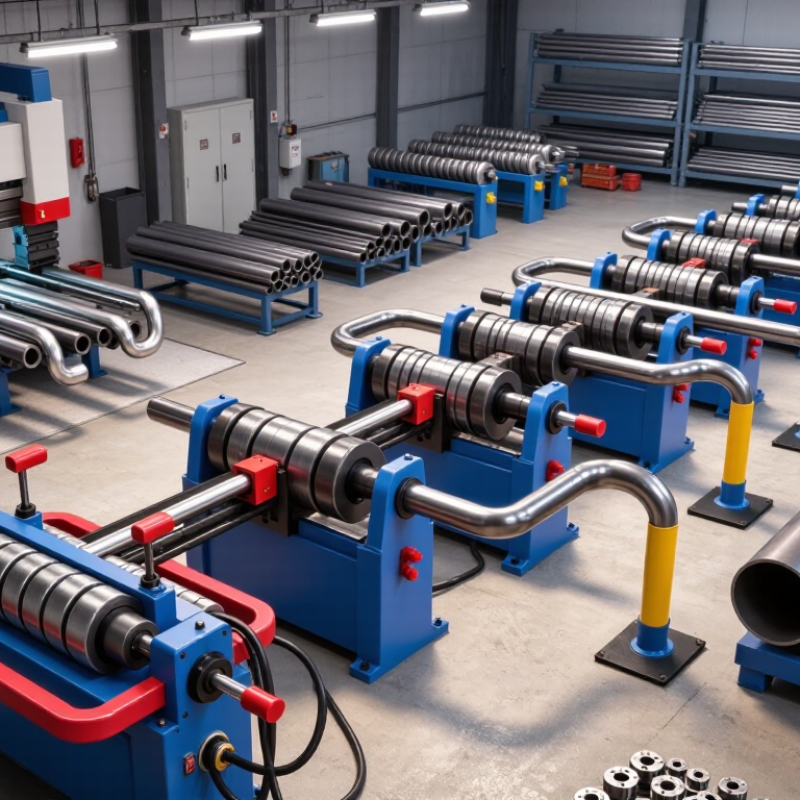
A high-quality China iron pipe bending machine begins with mechanical stability. The frame should remain rigid when thick pipe meets heavy forming pressure. Welds need clean penetration, not just a polished surface. During factory inspections, I check for vibration around the bending head and guide rails. Small movement can create visible wrinkles, especially on long iron sections.
Control accuracy matters just as much. A reliable machine should provide repeatable bending angles, steady speed, and simple parameter adjustment. Digital controls help operators store common production settings. However, software alone does not guarantee precision. I compare several test bends with a calibrated angle gauge. The results should remain consistent after continuous operation. Hydraulic systems also need leak-resistant fittings and accessible maintenance points. Poorly placed fittings can turn a routine repair into unnecessary downtime.
Material compatibility deserves careful attention. A machine designed for thin tubing may struggle with heavy iron pipe. Ask for real test samples using your pipe diameter, wall thickness, and bending radius. I once trusted a specification sheet without requesting enough samples. The first production run exposed slight flattening near the bend. That mistake changed my inspection process. Now, I examine surface marks, ovality, noise, and temperature during testing. Clear manuals, responsive technical support, and available replacement parts also indicate dependable manufacturing. A strong machine is not merely powerful; it performs predictably on the workshop floor.
The best China iron pipe bending machine depends on the pipe, radius, volume, and required surface quality. Rotary draw bending suits precise elbows, handrails, frames, and hydraulic lines. A mandrel supports the inside wall during bending. This reduces wrinkling and ovality in thin-wall iron pipes. It needs accurate dies and careful setup.
Roll bending works better for large radii and long sections. Three rollers gradually shape pipes for structural supports, curved rails, and industrial rings. It creates less severe local stress, but repeated passes may be necessary. Press bending is practical for thick-wall pipes and lower production volumes. It costs less in tooling, although the bend can show flattening or pressure marks.
Hot induction bending suits heavy pipes requiring broad, smooth curves. Controlled heat softens a narrow section before forming. Operators must monitor temperature, cooling speed, and wall thinning. Otherwise, the finished pipe may lose consistency. When assessing a machine made in China, check its diameter range, motor capacity, control accuracy, tooling options, and sample results. Ask for measured bend angles, ovality, and springback data. Do not trust appearance alone. A polished test piece can hide small dimensional errors. In workshop trials, I would bend several pipe sizes, inspect the inner radius, and repeat the cycle after the machine warms up. Small differences matter.
| Bending Method | Suitable Machine Type | Typical Iron Pipe Profile | Typical Bend Radius | Best Applications | Main Advantages | Important Limitations | Overall Suitability |
|---|---|---|---|---|---|---|---|
| Rotary Draw Bending | CNC tube and pipe bender with pressure die, clamp die, and mandrel option | Round or square steel and iron pipes; thin- to medium-wall tubing | Commonly about 1.5–4 times the outside diameter, depending on material, tooling, and wall thickness | Automotive structures, furniture frames, handrails, machinery guards, exhaust components, and precision frames | High repeatability, accurate bend angles, good surface control, and suitability for complex multi-bend parts | Higher tooling cost; very small radii may require a mandrel and wiper die; setup must match the pipe dimensions | Best general-purpose choice for accurate production bending |
| Three-Roll Bending | Three-roll pipe or section bending machine | Medium- and large-diameter round pipe, square tube, and structural sections | Usually larger radii than rotary draw bending; the minimum depends on roll diameter, material, and section stiffness | Arched frames, circular structures, greenhouse supports, architectural rails, tanks, and structural rings | Handles long workpieces and large radii; flexible for different profiles; suitable for gradual curves | May leave a straight end at each side; springback and ovalization require process adjustment; less suitable for tight, short-radius bends | Best for large-radius curves and structural pipe forming |
| Press Bending | Hydraulic or mechanical press bender with a punch and die | Heavy-wall pipe and large structural sections, especially where moderate accuracy is acceptable | Typically medium to large radii determined by the die geometry | Construction supports, heavy frames, agricultural equipment, brackets, and repair or maintenance work | Simple tooling, strong forming force, relatively low initial investment, and useful for occasional or low-volume work | Greater risk of flattening, wrinkling, and surface marks; limited control for multiple bends and thin-wall pipe | Best for heavy-duty, low-volume, or less demanding applications |
| Mandrel Bending | Rotary draw bender equipped with a plug, ball, or articulated mandrel | Thin-wall pipe and tubing that must retain a controlled cross-section | Suitable for tight radii, often around 1–2 times the outside diameter when material and tooling allow | Fluid lines, precision handrails, vehicle tubing, heat-exchanger components, and visually sensitive frames | Reduces flattening and wrinkling; improves dimensional accuracy and internal flow area at tight bends | More setup time, greater tooling complexity, and higher maintenance requirements; lubricant selection is important | Best for tight-radius bends and high-quality thin-wall pipe |
| Induction Bending | Induction pipe-bending system with localized heating and controlled cooling | Large-diameter, thick-wall carbon-steel or alloy-steel pipe | Commonly used for long-radius bends; the allowable radius depends on pipe grade, diameter, wall thickness, and heating parameters | Oil and gas lines, power-plant piping, process pipelines, district heating, and large industrial structures | Can form large and heavy pipe with relatively low mechanical force; reduces the need for welded segmented elbows | High equipment cost, thermal distortion risk, energy consumption, and need for careful control of temperature and cooling | Best for heavy industrial pipe and large-diameter long-radius bends |
| Hot Bending | Hydraulic forming machine or furnace-assisted bending system | Heavy-wall and difficult-to-form iron or steel pipe requiring reduced forming resistance | Variable; large radii are generally easier to control, while tight bends require specialized dies and process validation | Large structural parts, high-strength steel components, industrial maintenance, and specialized fabrication | Lowers forming force and can improve formability of thick or high-strength materials | Heating may affect scale, dimensions, mechanical properties, and surface finish; cooling control is essential | Best when cold bending force or cracking risk is excessive |
| Manual or Portable Bending | Hand-operated lever bender, portable hydraulic bender, or compact electric bender | Small-diameter, relatively ductile pipe used in installation and field repair | Usually limited to the radii supported by the interchangeable formers | On-site plumbing, light construction, maintenance, fencing, and small fabrication projects | Portable, simple to operate, and economical for occasional work without automated programming | Lower throughput and repeatability; operator technique strongly affects angle accuracy and pipe deformation | Best for field work, prototypes, and small batches |
Choosing the best China iron pipe bending machine starts with capacity, not a catalog price. Check maximum pipe diameter, wall thickness, bending radius, and allowable steel grade. A machine rated for 60 mm tubing may struggle with thick-wall iron pipe. Ask for torque curves and continuous-duty data. Rated capacity can look impressive on paper.
Precision needs practical testing. Request sample bends using your actual pipe, tooling, and radius. Measure angle deviation, ovality, and wall thinning after repeated cycles. ISO 230-2 provides methods for evaluating positioning accuracy and repeatability in machine tools. However, pipe springback remains material-dependent. A clean first sample does not prove stable production. I would test at least 30 consecutive bends. That is often overlooked.
Automation should reduce handling errors, not merely add screens. Servo-controlled axes, automatic clamping, pressure-die control, and recipe storage improve consistency. Sensors can detect slipping or incomplete clamping before scrap increases. The International Federation of Robotics reported 276,288 industrial robots installed in China during 2023, representing about 51% of global installations. Its World Robotics 2024 report also recorded approximately 470 robots per 10,000 manufacturing employees in China. These figures show strong automation momentum, but they do not guarantee a good bending process. Compare cycle time, changeover minutes, operator training, maintenance access, and service response. The cheapest machine may become expensive when tooling alignment drifts.
This comparison uses representative specifications commonly found across China’s industrial pipe-bending machine market. Larger tube capacity supports heavier workpieces, while lower repeatability error indicates higher precision. Automation is rated on a 1–5 scale, from manual operation to highly automated CNC production.
The best machine combines controlled bending, visible safety features, and dependable technical support. Safety should be checked before production speed.
Guards are non-negotiable. A covered bending area helps prevent contact with moving dies and pipe sections.
An accessible emergency stop should halt motion immediately. Interlocked doors are valuable because the machine cannot operate while open.
Overload protection also reduces damage when a pipe, die, or setting is unsuitable. Clear control panels, foot-switch protection, and stable platforms make daily operation less tiring.
Inspect hydraulic hoses, fittings, electrical connections, and die surfaces every shift. Small leaks grow.
Lubricate moving points according to the manual, not personal guesswork.
Check bending angles with a calibrated gauge during regular production.
Records matter. A simple log can show recurring drift, unusual noise, or delayed cylinder movement.
I would not trust a machine described as maintenance-free. That promise sounds attractive, but it rarely matches workshop reality.
Ask whether technicians provide installation guidance, operator training, troubleshooting videos, and clear spare-parts lists.
Remote diagnosis can shorten downtime, especially when error codes and photographs are shared accurately.
Local response capability may matter more than a low purchase price.
Confirm warranty terms, software support, replacement-part availability, and expected response times in writing.
A detailed manual is essential, yet some manuals remain too general for new operators. That weakness should be discussed before payment.
Selecting the best China iron pipe bending machine starts with your actual production requirements, not the lowest quoted price. Measure the pipe’s outer diameter, wall thickness, material, bending radius, and monthly output. A machine designed for thin decorative tubing may struggle with thick structural pipe. Check the rated capacity carefully.
Ask the manufacturer for sample bends using your own pipe. Inspect the curve for wrinkles, flattening, cracks, and springback. This practical test often reveals more than a sales specification. Confirm whether the machine supports hydraulic, electric, or hybrid operation. Electric systems can offer precise control, while hydraulic designs may suit heavier work. Tooling must match your pipe size and radius.
Review the control system, emergency stop, guarding, setup time, and maintenance access. Request operating manuals, inspection records, and evidence of quality testing. Reliable suppliers should explain accuracy tolerances and provide clear after-sales support. Spare parts availability also matters when production cannot wait. A cheaper machine may create hidden costs through setup errors and rejected bends. I have seen buyers overlook tooling prices, then revise their budgets later. No checklist is perfect. Ask an experienced technician to inspect the machine before payment, especially when your production process is still changing.
Watch video