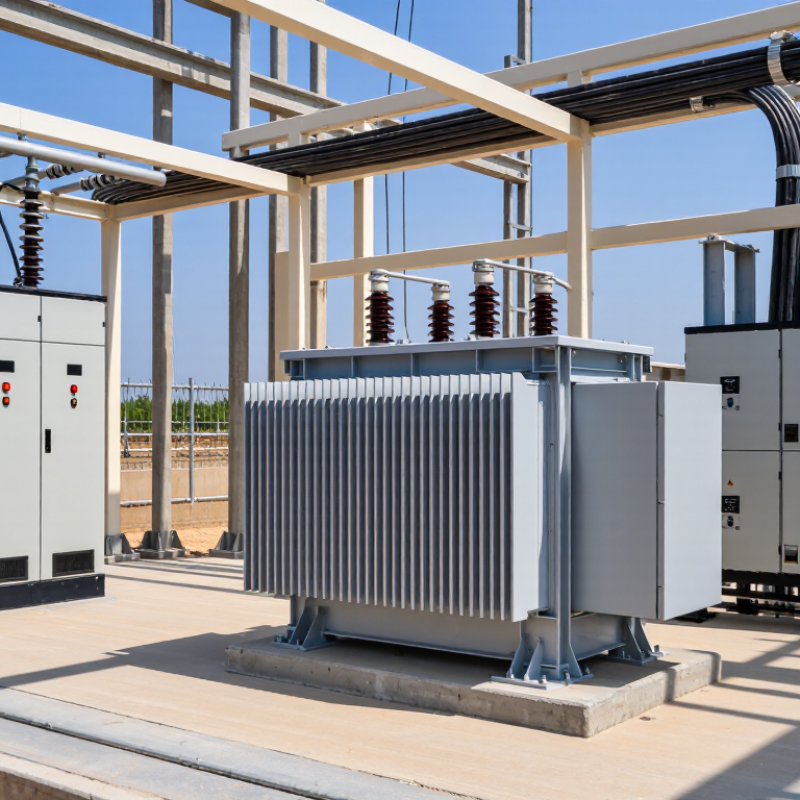
What Is the Best China Dry Type Transformer Substation?

Choosing the best China Dry Type Transformer Substation requires more than comparing prices or nameplate capacity. Performance depends on the site, load profile, climate, safety requirements, and maintenance plan.

A well-designed Dry Type Transformer Substation may combine a cast-resin transformer, medium-voltage switchgear, low-voltage distribution equipment, protection relays, and a compact enclosure. In a 10 kV to 0.4 kV application, engineers should verify rated capacity, impedance, insulation level, temperature rise, noise, and short-circuit withstand. Small details matter. A 5 millimeter ventilation gap can affect cooling, while poor cable bending space can delay installation.

Reliable manufacturers provide traceable test reports, clear factory acceptance procedures, and evidence of compliance with applicable IEC or Chinese standards. Their engineers should explain winding materials, resin quality, partial-discharge control, enclosure protection, and service support. Site experience also matters. A transformer that performs well in a dry factory may need different protection in a coastal or dusty environment.

There is no universal winner. That assumption can fail. The “best” supplier should match the project’s technical risks, delivery schedule, budget, and long-term operating conditions. Buyers should inspect production records, review previous installations, and request practical maintenance guidance. They should also question unclear efficiency claims and unusually low quotations. A careful comparison reveals whether the equipment offers genuine reliability or only attractive specifications. This guide examines those factors and helps readers make a more defensible selection.

What Is the Best China Dry Type Transformer Substation?

What Is a China Dry Type Transformer Substation?

What Is the Best China Dry Type Transformer Substation?

A China dry type transformer substation combines a dry type transformer with switchgear, protection devices, and a controlled enclosure. It changes medium-voltage electricity into safer, usable power for factories, buildings, and infrastructure. Unlike oil-filled equipment, it uses solid insulation and air cooling. This reduces leakage concerns and simplifies indoor installation. However, it still needs proper ventilation and regular inspection.

The best China dry type transformer substation depends on load demand, site conditions, safety requirements, and maintenance plans. Engineers should check transformer capacity, insulation class, temperature rise, noise level, and short-circuit strength. Applicable GB or IEC requirements should also be verified with test reports and technical drawings. In field inspections, cable access and heat dissipation often matter more than appearance. A clean enclosure proves very little. That detail is easy to miss.

Tips: Confirm the actual load before selecting capacity. Leave enough space around ventilation openings. Check grounding continuity during commissioning. Ask for routine test records, protection settings, and spare-part details. Dusty sites may require stronger enclosure protection. Humid areas need anti-condensation measures. One practical concern remains: many specifications focus on the transformer but neglect the complete substation system. That can create avoidable delays during installation and operation.

How Does a Dry Type Transformer Substation Work?

What Is the Best China Dry Type Transformer Substation?

A dry type transformer substation transfers electrical energy without liquid insulation. Its primary winding receives medium-voltage power. The magnetic core creates a changing field. This field induces a lower voltage in the secondary winding. Copper or aluminum conductors then deliver power to the low-voltage switchgear. No oil tank is involved.

Air or solid resin insulates the windings. Resin-encapsulated designs resist moisture and dust more effectively in demanding indoor spaces. Cooling usually depends on natural air movement. Fans may start when temperature sensors detect heavier loading. During site inspections, technicians often check ventilation openings, terminal tightness, dust buildup, and unusual noise. Small details matter.

A suitable China dry type transformer substation should match the load profile, short-circuit level, altitude, and local fire requirements. Its enclosure must protect energized parts while allowing safe heat release. Protection settings should coordinate with upstream and downstream equipment. Testing should cover insulation resistance, winding resistance, ratio, polarity, and temperature controls. Standards such as IEC 60076 and applicable Chinese GB requirements provide useful references.

A dry unit is not maintenance-free. That assumption needs checking. Poor airflow can raise winding temperature, reduce service life, and cause nuisance trips. In real installations, future load growth is also easy to underestimate. Leaving reasonable capacity may increase initial cost, but it can prevent forced replacement later. The best design is therefore not simply the smallest or most powerful unit. It is the one that operates steadily under actual site conditions.

Which Features Define the Best China-Made Models?

What Is the Best China Dry Type Transformer Substation?

The best China-made models combine safety, efficiency, serviceability, and verified manufacturing quality. A strong unit should use cast-resin insulation with low partial discharge. This helps protect windings in dusty or humid facilities. Copper conductors, reinforced insulation, and accurate temperature sensors also matter. They reduce thermal stress during heavy loads. Quiet operation is important near offices, hospitals, and residential buildings. A practical enclosure should resist dust and accidental contact. Check its protection rating for the actual installation environment.

Cooling design deserves close attention. Natural air cooling may suit moderate loads, while forced air cooling supports demanding duty cycles. Look for clear airflow paths, accessible filters, and replaceable fans. Certified tests should cover insulation strength, temperature rise, losses, noise, and short-circuit performance. Documentation should identify materials, test results, serial numbers, and maintenance intervals. Compliance with applicable IEC or national standards adds confidence, but certificates alone are not enough. Factory inspection and witnessed testing can reveal workmanship problems early. Ask about local spare parts and technical response times.

No model is best for every project. A compact substation may sacrifice future capacity. A larger unit may waste energy at light load. This trade-off is easy to overlook. Engineers should compare lifecycle costs, not only purchase prices. In real installations, poor ventilation can defeat an otherwise efficient transformer. Site conditions must guide the final specification.

How to Compare Safety, Efficiency, and Maintenance Requirements?

What Is the Best China Dry Type Transformer Substation?

The best dry type transformer substation depends on verified performance, not a catalog label. Compare safety through insulation class, enclosure protection, temperature sensors, and partial discharge results. Cast-resin transformers resist moisture and fire better than many basic designs, but installation still matters. Check clearance, ventilation, earthing, and access for emergency isolation. Independent test reports should follow IEC 60076-11 and applicable local requirements. Ask for factory records, not promises.

Efficiency requires more than low no-load losses. Review load losses, expected operating hours, harmonic content, and the actual load profile. A transformer running at 40% load may need different optimization than one serving a factory at 90%. Good airflow reduces thermal stress and energy waste. However, a larger unit is not automatically more efficient. Oversizing can increase idle losses and purchase costs. Engineers should compare measured data under realistic conditions.

Tips: Request temperature-rise data, sound levels, and short-circuit withstand results. Inspect cable termination space before ordering. Keep filters and ventilation paths clean. Use thermal imaging during scheduled inspections.

Maintenance is usually simpler because there is no insulating oil, yet “maintenance-free” is misleading. Dust, loose connections, blocked ducts, and aging sensors still create risks. A practical inspection plan may include torque checks, insulation testing, and alarm verification. No comparison is perfect. A spreadsheet can miss poor site conditions. Field experience should challenge the numbers.

What Is the Best China Dry Type Transformer Substation? — How to Compare Safety, Efficiency, and Maintenance Requirements
Typical engineering comparison for indoor or outdoor dry-type transformer substations using a 10 kV / 0.4 kV transformer, generally rated from 630 kVA to 1,600 kVA. Values are representative design ranges and should be confirmed against the project specification, local grid conditions, and applicable standards.
Evaluation Dimension Cast-Resin, Natural Air Cooling
(AN)
Cast-Resin, Forced Air Cooling
(AF)
VPI, Natural Air Cooling
(AN)
VPI, Forced Air Cooling
(AF)
Typical application Commercial buildings, hospitals, data rooms, transport facilities, and industrial plants requiring strong fire and moisture resistance. High-load or space-limited substations where short-term overload capacity is important. General industrial and utility installations with a controlled, relatively clean indoor environment. Industrial facilities requiring compact equipment and increased loading flexibility.
Common voltage and capacity range Up to approximately 35 kV; commonly 50–2,500 kVA for indoor substations. Up to approximately 35 kV; commonly 630–3,150 kVA when fan-assisted cooling is specified. Up to approximately 35 kV; commonly 50–2,500 kVA depending on insulation design. Up to approximately 35 kV; commonly 630–3,150 kVA depending on enclosure and ventilation.
Fire safety Very high — solid epoxy insulation contains no liquid dielectric and can be specified with a self-extinguishing system. Very high — same solid insulation benefit, with additional fan and control-system requirements. High — no liquid dielectric, but resin and insulation materials must be evaluated for fire performance. High — no liquid dielectric, but forced airflow can increase the importance of enclosure and fire-control design.
Moisture and pollution resistance Excellent when the resin surface is properly manufactured and the enclosure prevents condensation. Excellent, although fan openings and filters require protection in dusty or humid environments. Good in clean, dry locations; surface contamination and moisture can reduce insulation performance more quickly. Good, but ventilation openings and cooling fans need additional environmental protection.
Typical insulation system Cast epoxy resin around the windings with solid insulation and no liquid cooling medium. Cast epoxy resin with temperature-controlled axial fans for additional heat dissipation. Vacuum-pressure impregnated resin insulation, normally supported by air gaps and insulation barriers. VPI insulation with temperature-controlled forced-air cooling.
Cooling method AN: natural air circulation. AF: natural air cooling plus fans activated by temperature or load. AN: natural air circulation. AF: natural air cooling plus fan-assisted heat removal.
Typical temperature-rise class Commonly 100 K or 80 K, depending on the thermal design and efficiency target. Typically 100 K under AN rating; AF operation may provide additional capacity without changing the basic insulation class. Commonly 100 K or 80 K, subject to the selected insulation system and design temperature. Typically 100 K under AN rating, with higher permissible loading when AF cooling is available.
Energy efficiency Typical full-load efficiency is approximately 98.0%–99.0% for modern distribution ratings; low-loss designs may perform better. Similar transformer efficiency to AN operation, but auxiliary fan consumption slightly increases total system energy use. Typical full-load efficiency is approximately 97.5%–98.8%, depending on core material, winding design, and losses. Similar transformer efficiency to AN operation, with additional fan energy consumption during AF operation.
No-load loss trend Usually low when high-grade electrical steel or amorphous-metal core technology is selected. Comparable to the AN version because no-load loss is primarily determined by the magnetic core. Comparable to cast-resin designs with the same core material and flux density. Comparable to the AN version because forced cooling mainly affects heat removal rather than core loss.
Short-circuit impedance Commonly around 4%–8% for medium-voltage distribution transformers; the final value must match the system fault-current study. Commonly around 4%–8%, subject to the same system coordination requirements. Commonly around 4%–8%, subject to winding geometry and the required short-circuit withstand level. Commonly around 4%–8%, subject to the same protection and fault-current requirements.
Partial discharge performance Well-designed cast-resin units are commonly specified at ≤10 pC at the applicable test voltage. Well-designed cast-resin units are commonly specified at ≤10 pC; fan operation does not directly affect partial discharge. Performance depends strongly on impregnation quality; project specifications may require values such as ≤20 pC. Performance depends on impregnation quality and thermal cycling; project specifications may require values such as ≤20 pC.
Noise level at 1 m Typically approximately 55–65 dB(A), depending on rating, core design, and enclosure. Typically approximately 60–75 dB(A) when fans are operating. Typically approximately 55–65 dB(A), depending on rating and magnetic flux density. Typically approximately 60–75 dB(A) when fans are operating.
Overload capability Moderate; short-term overload depends on the thermal design, ambient temperature, and starting conditions. Higher flexibility — AF cooling can increase permissible loading for defined periods when approved by the manufacturer. Moderate; thermal performance is more sensitive to ventilation and winding temperature. Higher flexibility — fan-assisted cooling supports higher loading within the approved thermal limits.
Routine maintenance Generally limited to visual inspection, cleaning, checking connections, and verifying temperature-monitoring equipment. Includes all AN checks plus fan, relay, sensor, filter, and control-circuit inspection. Requires cleaning, inspection for surface tracking or cracking, connection checks, and environmental control. Includes all VPI AN checks plus inspection and functional testing of the fan and control system.
Recommended inspection interval Visual inspection every 6–12 months; more frequent cleaning in dusty or humid locations. Visual inspection every 3–6 months; fan and control checks at least annually or according to operating hours. Visual inspection every 6–12 months, with increased frequency in polluted environments. Visual inspection every 3–6 months; fan and control checks at least annually.
Main maintenance risks Dust accumulation, loose terminals, blocked ventilation paths, condensation, and abnormal temperature rise. Fan failure, blocked filters, sensor faults, control-circuit failure, dust accumulation, and abnormal temperature rise. Moisture absorption, surface contamination, insulation aging, partial discharge, and thermal stress. All VPI risks plus fan failure, airflow restriction, and control-system malfunction.
Space and installation requirements Requires adequate clearance for natural ventilation and safe access for inspection. Requires additional space or provisions for fans, airflow, filters, and noise control. Requires a clean and dry room with reliable ventilation and condensation control. Requires reliable ventilation, fan discharge space, and protection against dust and water ingress.
Typical lifecycle cost profile Balanced — higher initial cost than some VPI designs, but low routine maintenance and strong environmental tolerance. Higher initial and operating cost because of fans and controls, offset by improved overload capability where needed. Potentially economical in clean indoor environments, but environmental maintenance can be more demanding. Moderate to high lifecycle cost due to additional auxiliary equipment and maintenance requirements.
Best selection priority Safety, low maintenance, moisture resistance, and stable operation Overload capacity, compact installation, and high load fluctuation Controlled indoor environment and cost-sensitive industrial distribution High utilization, forced cooling, and flexible capacity management
Relevant standards to verify IEC 60076-11 or GB/T 1094.11, plus applicable fire, enclosure, EMC, and local electrical installation requirements. IEC 60076-11 or GB/T 1094.11, including requirements for cooling equipment, controls, alarms, and protection coordination. IEC 60076-11 or GB/T 1094.11, together with project requirements for insulation, fire performance, and environmental conditions. IEC 60076-11 or GB/T 1094.11, including forced-cooling control, alarm, interlock, and standby-operation requirements.
Practical selection guidance: For most indoor China dry-type transformer substations, a cast-resin AN transformer is often the most balanced choice when safety, moisture resistance, and low maintenance are the main priorities. A cast-resin AF design is more suitable where load peaks or short-term overloads justify the additional fan and control-system maintenance. The final selection should be based on load profile, ambient temperature, ventilation, harmonic content, short-circuit level, fire requirements, noise limits, and total lifecycle cost.

How to Select the Right Supplier and Substation Configuration?

What Is the Best China Dry Type Transformer Substation?

Selecting the right supplier starts with verifiable engineering evidence, not a low quotation. The IEA’s Electricity 2024 report expects global electricity demand to grow by about 3.4% annually through 2026. This growth increases pressure on reliable distribution equipment, especially in industrial parks and renewable-energy projects.

Ask suppliers for IEC 60076-11 compliance, routine test records, partial-discharge results, temperature-rise data, and documented quality controls. Factory inspection should include winding condition, insulation clearance, noise testing, and enclosure protection. Certificates alone are not enough.

Configuration must match the site. Confirm primary and secondary voltage, rated capacity, vector group, impedance, frequency, altitude, ambient temperature, and required IP rating.

For dusty workshops, a sealed enclosure may be safer than an open design. For buildings, consider low flammability, ventilation, emergency access, and noise limits.

Harmonic-producing loads may require a larger neutral conductor or a transformer designed for nonlinear loads.

Parallel operation also demands compatible impedance and phase relationships.

The China Electricity Council reports continued expansion in China’s power infrastructure, but local conditions vary sharply. Coastal humidity, inland dust, and high-altitude cooling needs cannot share one standard specification.

A cheaper unit may pass basic tests yet perform poorly under repeated overloads. That risk is easy to underestimate.

Review maintenance access, spare-part availability, response times, and warranty exclusions in writing. The best supplier is not always the largest. It is the one that can explain every design choice with testable data.

Smart Robotics brand movie

Watch video