Best Auto Phone Holder Manufacturers in China

Choosing among the Best Auto Phone Holder Manufacturers in China takes more than comparing prices. A holder may look sturdy in a product photo, then sag when a phone warms in afternoon sunlight. Buyers should examine clamp strength, hinge wear, vibration control, and fit across phone sizes. Small details matter.

Human-factors researcher Dr. David Strayer has studied how phone-related tasks compete with driving attention. A paraphrased takeaway from his research is: “Keep interaction brief; attention belongs on driving.” A well-designed Auto Phone Holder should keep the screen easy to locate without encouraging prolonged use. No mount can make distracted driving safe.

This guide explores Chinese manufacturers through practical buying criteria: materials, testing practices, customization, production capacity, and communication. Ask for close-up photos of joints and suction pads. Request samples for testing on rough roads and in hot cabins. Check whether the supplier explains limitations clearly. That answer can reveal more than a polished brochure.

There are trade-offs. A strong magnetic mount may need a compatible plate, while a vent clip can strain delicate louvers. Some specifications are difficult to compare without independent testing. That is worth admitting. The manufacturers worth considering are those that provide verifiable product details, consistent samples, and realistic support—not just the lowest quote.
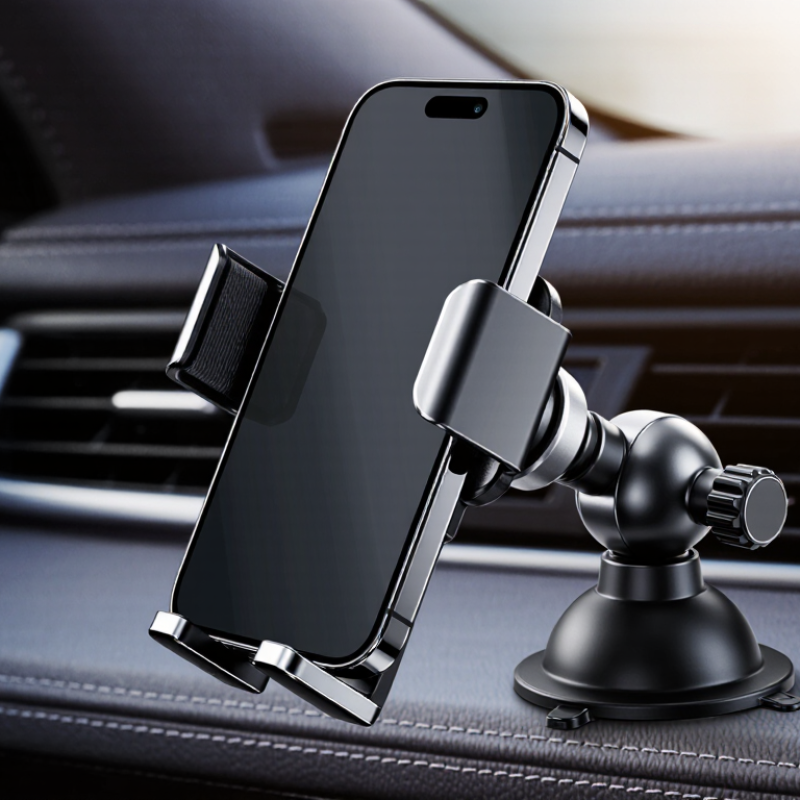
Best Auto Phone Holder Manufacturers in China

Auto Phone Holder Types and Qi2’s 15 W Wireless-Charging Profile

Auto phone holders generally use vent clips, dashboard or windshield suction cups, adhesive bases, or cup-holder stems. Each suits a different cabin. Vent mounts are compact, but a heavy phone can make a loose vent wobble. Suction mounts offer flexible positioning; dust or textured surfaces can weaken their grip. Fit matters. Check that the holder stays clear of the driver’s view and does not block essential controls.

Qi2 adds a charging standard to the mounting choice. The Wireless Power Consortium’s Qi2 specification supports up to 15 W through its Magnetic Power Profile, which aligns charging coils magnetically. That alignment can make placement easier than on a basic wireless pad. But a magnetic holder alone does not guarantee Qi2 charging; the phone and charger must support the profile.

Heat also matters. A sunlit windshield and active navigation can warm a phone, so charging may slow to manage temperature. This is where specifications can disappoint in real cars.

The market context is substantial: IDC reported 1.24 billion smartphone shipments worldwide in 2024, up 6.4% from 2023. That figure does not measure car-holder demand, but it shows why broad device compatibility matters. For manufacturers in China, useful checks include clamp pressure, vibration resistance, cable routing, and reliable Qi2 alignment across phone sizes. Small details count. A mount can feel sturdy on a desk yet shift over rough pavement.

China’s Manufacturer Landscape in Context of OICA’s 93.5 Million 2023 Vehicles

Best Auto Phone Holder Manufacturers in China

OICA reported approximately 93.5 million motor vehicles produced worldwide in 2023. That figure sets the scale for China’s auto accessory manufacturing landscape, but it does not measure phone-holder demand or China’s share of holder production. It does show why suppliers serving vehicle makers and aftermarket sellers need dependable capacity. Scale matters.

For buyers, the useful questions are practical: Does the mount fit different dashboard shapes? Can its clamp hold a phone over rough roads? Does the suction base stay secure after repeated temperature changes? Ask for sample testing, material details, and clear inspection records. A neat catalogue is not proof of consistent quality. I would want to see the unit tested in a real vehicle, not only on a desk.

China’s manufacturing network can support varied designs, from vent clips to dashboard mounts, and production runs may be tailored to different device sizes. Yet broad capacity does not guarantee careful engineering. Fit is not universal. A vent clip that works in one cabin may block airflow or loosen in another. The 2023 production figure is useful context, not a shortcut to choosing a supplier. Specific tests and candid communication matter more.

How Leading Chinese Makers Engineer Mounts for Heat, Vibration, and Road Use

Chinese manufacturers designing mounts for road use begin with a practical question: will the holder stay steady after hours in a hot cabin? Dashboard surfaces can become much hotter than the surrounding air, and direct sunlight may soften some plastics or adhesive layers. Engineers compare materials and test samples in heated chambers before fitting them to vehicles. Small details matter. A thicker arm alone cannot prevent wobble; joint geometry and clamping force matter too.

Vibration testing checks more than whether a phone falls. Repeated bumps can loosen a ball joint, shift a spring clamp, or make the screen shake. Makers may adjust contact pads, hinge tolerances, and locking teeth, then run samples through repeated shaker-table cycles. They should test phones with different weights and case thicknesses. Fit is not universal. A mount that grips a light phone may behave differently with a heavier one.

Heat and vibration are only part of daily use. Drivers also need reachable controls, clear sightlines, and a release mechanism that works with one hand. Quality checks can include repeated installation, removal, and trials on rough pavement. One smooth route proves little. Manufacturers can document temperature ranges, cycle counts, and observed failures, rather than showing only a successful sample. Some compromises remain: stronger springs may improve grip but make frequent removal less comfortable.

Factory Vetting: ISO 9001, IATF 16949, and Qi Certification

A strong auto phone holder manufacturer should show how quality is controlled on the production floor, not just present polished certificates. Ask for the current ISO 9001 certificate and check that its legal entity, factory address, scope, and expiry date match the supplier you are evaluating. ISO 9001 covers a quality management system; it does not certify every holder as defect-free. That distinction matters.

For automotive-related production, IATF 16949 can indicate that a factory follows more demanding quality processes, including supplier controls and corrective actions. Verify the certificate with the issuing certification body and confirm that the listed site actually makes your product. Ask for recent inspection records, material traceability examples, and evidence of how defects are handled. A factory tour helps, but one tidy sample line is not the whole story.

Qi certification is relevant only when the holder includes a wireless charging function. Request documentation for the specific charging product and verify its status through the official Qi certification database; a supplier’s general claim is not enough. Then test samples in your own vehicle for grip, vibration, cable access, and heat during charging. Small differences in vent shape or dashboard texture can change performance. Paperwork can look convincing. I would still check the samples twice.

Best Auto Phone Holder Manufacturers in China — Factory Vetting: ISO 9001, IATF 16949, and Qi Certification

Vetting dimension Evidence to request What to verify Practical evaluation criterion
ISO 9001 quality management Current certificate and certification-body details Confirm the certificate is valid, covers the relevant manufacturing site, and includes an applicable scope. ISO 9001 addresses quality-management systems; it does not certify a specific phone holder or guarantee product performance. Treat certification as supporting evidence, then assess production controls, inspection records, and corrective-action procedures.
IATF 16949 automotive quality management Current certificate, site address, scope, and relevant customer-specific requirements Check that the certified site and scope are relevant to the supplied product and manufacturing activity. IATF 16949 is an automotive quality-management-system standard; it is not automatically required for every aftermarket accessory supplier. Confirm whether the buyer or end customer requires it, and distinguish a certificate held by the actual production site from one held by another entity.
Qi wireless charging certification Qi certification details for the exact wireless charging model Search the Wireless Power Consortium’s product database and match the listed product and manufacturer details to the offered model. Qi certification applies to wireless-power products, not to a non-charging phone holder as a whole. Do not rely only on a general “Qi compatible” claim; request model-specific evidence and confirm that the supplied version matches the listing.
Factory and production capability Factory address, production-flow overview, equipment list, and recent production records Establish whether the supplier manufactures the product, uses subcontractors, or performs only assembly or trading. Verify that the stated site matches the facility being assessed. Map each key process—such as molding, assembly, charging-module integration, and final inspection—to the responsible site.
Product safety and electrical checks Applicable test reports, component specifications, and risk-assessment records for charging models Confirm that reports identify the tested model and configuration. Applicable requirements depend on the product design and destination market; a test report for a different model may not support the offered product. Review protection features and test coverage relevant to the design, including temperature, electrical behavior, and abnormal-use conditions where applicable.
Mechanical durability and vehicle use Test plans and results for retention, vibration, adjustment cycles, and mount attachment Check the tested mounting method, phone-size range, test conditions, and acceptance criteria. Results should correspond to the product configuration being quoted. Compare documented results with the intended vehicle environment and use case; request a sample for independent evaluation where appropriate.
Incoming, in-process, and final inspection Inspection checklists, defect records, and sample inspection reports Look for documented checks at relevant stages, defined acceptance criteria, traceable results, and a process for handling nonconforming parts. Verify that inspection covers the product’s critical features, such as locking, adjustment, attachment, finish, and charging function when included.
Change control and traceability Component and revision records, lot identification, and change-notification procedure Determine how changes to materials, components, tooling, software, or production location are reviewed and communicated. Require written approval for changes that could affect fit, function, quality, certification status, or agreed specifications.
Supplier selection decision Completed document review, sample evaluation, and factory-audit findings Assess certificate relevance and validity alongside product-specific evidence, production controls, and the supplier’s ability to meet the intended market requirements. Approve only after discrepancies are resolved and the exact product, site, specifications, and evidence are aligned.

Comparing Manufacturers by Product Range, MOQ, Testing, and Export Capability

A useful comparison starts with product range. Some manufacturers focus on vent-mounted holders, while others offer dashboard, windshield, and magnetic designs. Check whether the factory can adjust clamp width, joint angle, or contact-pad material for your target phones. Small details matter: a holder that slips on a rough road will quickly disappoint. Ask for samples from the same production line, not just showroom pieces.

Minimum order quantities can differ by model, color, packaging, and custom tooling. A low MOQ may suit a trial order, but confirm the unit price and repeat-order terms in writing. Testing deserves the same attention. Request reports for the exact model and ask how teams check grip strength, joint movement, and temperature performance. A neat report is helpful; a clear test method is better. I would not assume every listed test is performed on every batch.

Export capability is more than shipping experience. Ask whether the supplier can prepare clear product specifications, carton details, and consistent shipping documents. Confirm lead times for samples and bulk orders, and ask how delays are handled. A brief video of the packing process can reveal practical details, such as whether holders are protected from scratches. Still, documents and calls cannot replace inspection. That part is easy to underestimate.

Best Auto Phone Holder Manufacturers in China: A Supplier Evaluation Checklist

Compare product range, MOQ, testing, and export capability using verifiable questions.

Checklist points counted in the chart

  • Product range: dashboard, windshield, and air-vent mounting styles.
  • MOQ: minimum order quantity for standard products and customized products.
  • Testing: vibration, temperature, and device-fit checks.
  • Export capability: export documents, packaging requirements, and shipping terms.

The bars count the verification points listed above; they are not supplier ratings, market statistics, or claims about any specific manufacturer. Confirm requirements and test procedures directly with each supplier.

Smart Robotics brand movie

Watch video