Why Choose Robotic Process Automation Tools for Your Business?
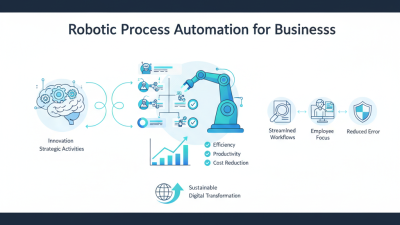
In today's fast-paced business environment, organizations seek efficiency and accuracy. Robotic process automation (RPA) tools have emerged as a solution. They streamline repetitive tasks and reduce human error. Companies are increasingly adopting robotic process automation tools to enhance productivity.
These tools allow businesses to automate mundane operations. This leads to cost savings and improved accuracy. Employees can focus on strategic tasks instead of routine work. However, businesses must assess their specific needs before implementation. Not all automation tools fit every organization.
While the benefits are clear, challenges may arise. Employees might resist changes to established workflows. Moreover, integrating new technologies can pose difficulties. It’s essential to address these concerns head-on. Overall, the potential of robotic process automation tools is significant. Yet, businesses must approach this transformation thoughtfully.

Understanding Robotic Process Automation (RPA) and Its Benefits
Robotic Process Automation (RPA) is transforming the way businesses operate. It allows organizations to automate repetitive tasks and increase overall efficiency. Imagine a scenario where data entry takes hours. With RPA, that same task can be completed in minutes, freeing up valuable time for employees.
Understanding RPA requires recognizing its various applications. For instance, RPA can streamline invoicing in finance departments. However, not every process is suitable for automation. Businesses must evaluate which tasks truly benefit from RPA. A task that seems simple may have complexity hidden beneath the surface.
The benefits of RPA extend beyond time savings. It enhances accuracy and reduces human error. Still, companies should be cautious. Implementing RPA without proper planning can lead to frustration. An effective strategy is essential to harness its full potential. While RPA offers significant advantages, it is not a silver bullet. Continuous assessment and adjustment are crucial for successful adoption.
Key Advantages of Implementing RPA Tools in Business Operations
Robotic Process Automation (RPA) is transforming business operations. Recent studies indicate that organizations implementing RPA can expect cost reductions of up to 30%. This reduction stems from the automation of repetitive tasks. Employees can then focus on higher-value activities. For instance, processing invoices or managing customer inquiries can be automated. This efficiency leads to increased productivity and faster service delivery.
Furthermore, RPA improves accuracy in operations. A report from Gartner states that RPA can reduce operational errors by 90%. This is critical in sectors where precision is essential, like finance and healthcare. Human errors are common in data entry tasks. RPA minimizes these errors significantly. Businesses are realizing a competitive edge through enhanced quality and lower risk of compliance failures.
However, the implementation of RPA is not without challenges. Change management can be difficult. Some employees may resist adopting new technologies. Training becomes essential to ensure smooth transitions. Metrics for success must also be clearly defined. Not all processes may be suitable for automation. Businesses should carefully evaluate which areas will benefit most from RPA. Balancing automation with human oversight is crucial for long-term success.
Key Advantages of Implementing RPA Tools in Business Operations
Identifying Tasks Suited for Automation with RPA Solutions
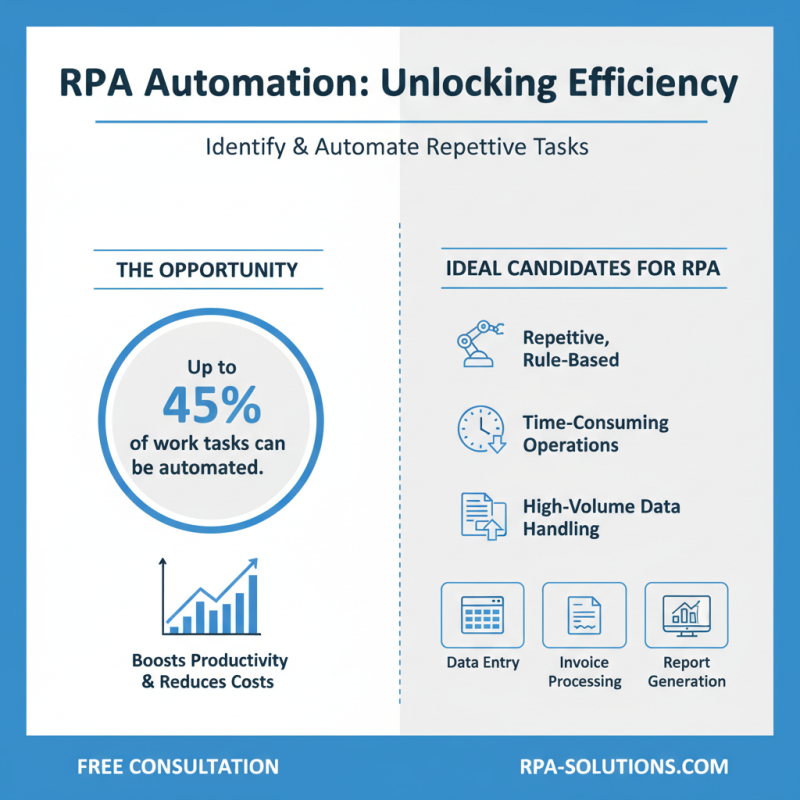
Identifying tasks suitable for automation is critical in implementing Robotic Process Automation (RPA) solutions. According to a McKinsey report, up to 45% of tasks in the workplace can be automated. This stark statistic underscores the importance of evaluating daily operations. Businesses often overlook repetitive, rule-based tasks that drain valuable employee time. Examples include data entry, invoice processing, and report generation.
Some organizations find that administrative tasks represent a significant opportunity. According to Forrester Research, automating just one administrative function can reduce costs by nearly 30%. However, it's essential to analyze the suitability of each task. Not every task benefits equally from automation. RPA excels in high-volume processes that require consistency and minimal human judgment. This may lead to organizations needing to reflect on which tasks should truly be automated.
On the flip side, the challenge remains in identifying these tasks correctly. Many companies struggle with inertia, sticking to traditional methods rather than embracing change. Employees may fear job loss or lack understanding of automation tools. Thus, creating an environment that supports RPA education is vital. It ensures employees see automation as a tool for growth, not as a threat.
Choosing the Right RPA Tools for Your Business Needs
Choosing the right Robotic Process Automation (RPA) tools can transform your business operations. According to a report by Gartner, enterprises implementing RPA experienced a 30% increase in productivity. These tools effectively automate repetitive tasks, allowing employees to focus on more strategic activities.
When selecting RPA tools, consider ease of integration with existing systems. A seamless connection minimizes disruption. A study from Deloitte revealed that 63% of companies faced obstacles during RPA implementation due to integration issues. Additionally, scalability is crucial. Select tools that grow as your business needs evolve.
User-friendly interfaces are essential for user adoption. Complex systems may lead to frustration and resistance among employees. Research from Forrester shows that user adoption rates drop significantly when interfaces are not intuitive. Remember, the right RPA solution should enhance efficiency, not create additional challenges. Ultimately, understanding your specific business needs is key. Each RPA tool has its strengths and weaknesses, making it vital to assess your requirements thoroughly.
Measuring the Impact of RPA on Business Efficiency and Productivity
Robotic Process Automation (RPA) offers remarkable potential for enhancing business efficiency. By automating routine tasks, RPA can free up valuable time for employees, allowing them to focus on higher-value work. For instance, a company that implements RPA may see a 30% reduction in time spent on data entry. This leads to quicker decision-making and an overall boost in productivity.
However, measuring the true impact of RPA can be nuanced. It's not just about speed; accuracy also plays a crucial role. Many organizations report fewer errors after deploying RPA tools. Yet, some face challenges when integrating this technology into established workflows. Misalignment between automated processes and human efforts can lead to friction. Continuous assessment and adaptation are vital to maximizing benefits.
Understanding these dynamics is essential for success. Businesses must share experiences and learn from peers navigating similar RPA journeys. Engaging with professional networks can foster insights about pitfalls and best practices. With careful implementation and ongoing evaluation, companies can harness RPA effectively, paving the way for sustained growth.
Why Choose Robotic Process Automation Tools for Your Business? - Measuring the Impact of RPA on Business Efficiency and Productivity
| Metric |
Before RPA |
After RPA |
Improvement (%) |
| Operational Costs |
$500,000 |
$350,000 |
30% |
| Processing Time (Hours) |
200 hours |
120 hours |
40% |
| Human Error Rate (%) |
7% |
1% |
85% |
| Employee Productivity (Tasks/Day) |
30 |
50 |
66.67% |