2026 Top Mezzanine Storage Rack Suppliers for Global Buyers
Choosing a Mezzanine Storage Rack supplier in 2026 requires more than comparing prices, photographs, or warehouse capacity. Global buyers must examine engineering quality, load calculations, material traceability, installation support, and after-sales responsiveness. A rack may look strong on a factory floor, yet perform poorly when pallet weights, forklift traffic, or seismic conditions change. Small details matter. Floor anchors matter. Guardrails matter. So does the supplier’s willingness to explain limitations.
James A. Tompkins, a widely recognized warehouse-design authority, offers a useful principle: “A warehouse is a system, not merely a building.” That idea remains highly relevant to Mezzanine Storage Rack selection. The platform, stairs, decking, shelving, conveyors, lighting, and fire-safety provisions must work together. One isolated specification cannot prove overall suitability. Experienced buyers should request drawings, tested load data, production records, and references from comparable facilities. They should also confirm whether the supplier understands local installation requirements and operational risks.
This guide reviews the 2026 Top Mezzanine Storage Rack Suppliers for Global Buyers through a practical, evidence-based lens. It considers product versatility, customization, manufacturing consistency, technical service, delivery capability, and communication across borders. However, no ranking can replace site-specific assessment. That is the uncomfortable part. A reputable supplier can still be unsuitable for a low-clearance warehouse or uneven concrete floor. Buyers should measure twice, challenge unclear claims, and document every assumption before signing. Reliable storage begins with careful questions, not attractive brochures.
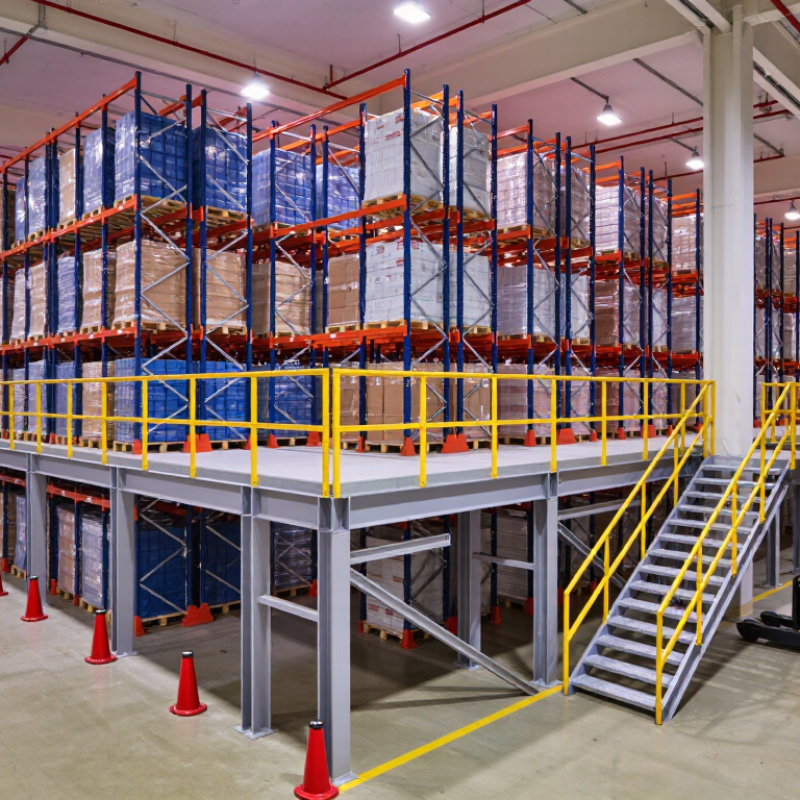
Table of Contents [Hide]
What Mezzanine Storage Racks Are and How They Expand Warehouse Capacity
Mezzanine storage racks are elevated steel platforms supported by rack frames, columns, or both. They create a second storage level without requiring a new building. Beneath the platform, forklifts can handle pallets. Above it, workers can store cartons, spare parts, or slow-moving inventory. This vertical arrangement can significantly increase usable warehouse capacity.
A practical system begins with accurate measurements. Buyers should check clear height, floor strength, aisle width, pallet dimensions, and sprinkler clearance. A 5.5-meter warehouse may support two levels, but beams, lighting, and fire equipment reduce available space. Load ratings must reflect real pallet weights, not optimistic estimates. Professional suppliers should provide structural calculations, layout drawings, guardrails, stair access, and installation guidance. Local engineering review remains important because warehouse requirements differ between countries.
The best design also supports daily work. Smooth deck surfaces reduce cart vibration, while pallet gates help protect operators at transfer points. Adjustable beams can accommodate changing stock sizes. Yet flexibility has limits. A rack that looks efficient on paper may create slow picking routes on the floor. I have seen storage density improve while order handling became harder. Buyers should test one aisle with actual pallets and walking distances before approving a full installation. Clear labels, impact protection, inspections, and staff training matter as much as steel thickness. Good capacity planning leaves room for mistakes, maintenance, and future growth.
2026 Top Mezzanine Storage Rack Suppliers for Global Buyers - What Mezzanine Storage Racks Are and How They Expand Warehouse Capacity
A practical, brand-neutral comparison framework for evaluating mezzanine storage rack solutions, capacity gains, engineering requirements, and supplier capabilities.
| Evaluation Dimension | Verified Industry Reference | Why It Matters to Global Buyers | Recommended Supplier Evidence |
|---|---|---|---|
| Definition | A mezzanine storage rack is an elevated, engineered storage level supported by rack frames, columns, or both. It creates usable vertical floor space without extending the building footprint. | It can increase storage density where the warehouse has sufficient clear height and floor capacity. | Technical drawings showing the support arrangement, load path, access points, and connection details. |
| Common system types | Rack-supported, free-standing structural, shelving-supported, and multi-tier systems are common configurations. | The correct type depends on pallet access, carton picking, floor loading, building height, and future expansion plans. | A layout proposal with at least two configuration options and stated assumptions. |
| Typical deck load range | Approximately 250–1,000 kg/m² is frequently specified for light- to heavy-duty mezzanine applications; the final rating must be engineered for the project. | The design load determines the steel members, decking, columns, foundations, and permitted inventory. | Stamped or signed structural calculations identifying uniformly distributed loads and concentrated loads. |
| Capacity expansion mechanism | Storage area is expanded vertically rather than by adding an equivalent amount of ground-level floor area. | A two-level arrangement can provide additional usable storage area, subject to aisle, stair, lift, safety, and building constraints. | A before-and-after capacity calculation based on actual pallet positions, bins, cartons, or picking locations. |
| Clear height requirement | The required building height depends on the lower operating zone, structural depth, upper storage height, sprinkler clearance, and material-handling equipment. | Insufficient clear height can reduce usable levels, obstruct sprinklers, or create unsafe access conditions. | A section drawing showing floor-to-floor heights, headroom, sprinkler clearance, lighting, and ventilation zones. |
| Decking options | Common options include steel grating, structural panels, composite decking, and steel floor plate, selected according to load and use. | Deck selection affects durability, fire performance, rolling equipment compatibility, noise, and total cost. | Product data showing panel thickness, allowable loads, deflection limits, surface properties, and fire classification where applicable. |
| Access and material flow | Typical access elements include stairs, handrails, pallet gates, loading gates, conveyors, and goods lifts. | Efficient access prevents the mezzanine from becoming a bottleneck in picking and replenishment operations. | An operational flow plan showing pedestrian routes, pallet transfer points, emergency exits, and equipment clearances. |
| Safety protection | Guardrails, toe boards, pallet gates, non-slip surfaces, stair handrails, impact protection, and controlled access are commonly required. | Protection systems reduce fall, dropped-load, collision, and unauthorized-access risks. | A compliance checklist covering local building, fire, occupational safety, and seismic requirements. |
| Floor and foundation assessment | Column reactions and rack loads must be checked against the existing slab, joints, soil conditions, and foundation design. | A structurally adequate superstructure may still be unsuitable if the slab cannot support concentrated loads. | Site survey data, slab thickness and strength records, anchor details, and reaction-load calculations. |
| Standards and approvals | Requirements vary by country and may include building codes, structural steel standards, fire codes, seismic provisions, and workplace safety rules. | Local approval obligations can affect design, lead time, insurance, and installation permission. | A country-specific compliance matrix and confirmation of who is responsible for permits and inspections. |
| International sourcing capability | A global project may require metric or imperial drawings, export packaging, multilingual documents, coordinated shipping, and local installation support. | Documentation and logistics quality can be as important as the steel system itself. | Incoterms, packing specifications, container-loading plans, quality records, installation method statements, and after-sales contacts. |
| Best-fit warehouse applications | E-commerce fulfillment, spare-parts storage, carton picking, archive storage, light manufacturing, kitting, and inventory overflow. | Mezzanine systems are particularly useful when inventory requires more cubic capacity but the facility footprint is constrained. | Reference layouts with product dimensions, throughput assumptions, picking methods, and measurable capacity outcomes. |
Important specification note: Load ratings, dimensions, fire protection, seismic design, and approval requirements are project-specific. A qualified local structural engineer should verify the final design before procurement or installation.
Customers




Smart Robotics brand movie
Watch video